Process Mining = Powerful Process Improvement
Full article: Your Business's X-Ray Vision for Seeing How Work Actually Gets Done (and Making It Way Better)
Every company has processes and procedures. On paper, they seem like sturdy pillars of your operation and gorgeous—clean flowcharts, swim lanes, perfect little boxes that make project managers weep with joy. In reality? Not so much. Loops no one planned, bottlenecks that suck the life out of teams, and "unofficial" workarounds that somehow keep the lights on or are unknowingly better than the "official way". Because what actually happens inside a business is often very different from what people think happens and processes that people think are good are not always beneficial.
That's where process mining comes in. It's like giving your operations a full-body MRI using the digital breadcrumbs your systems already leave behind. And with Agentic AI entering the scene, it's evolving from a cool diagnostic tool into an active co-pilot that doesn't just show problems—it helps fix them in near real-time.
So What Is Process Mining?
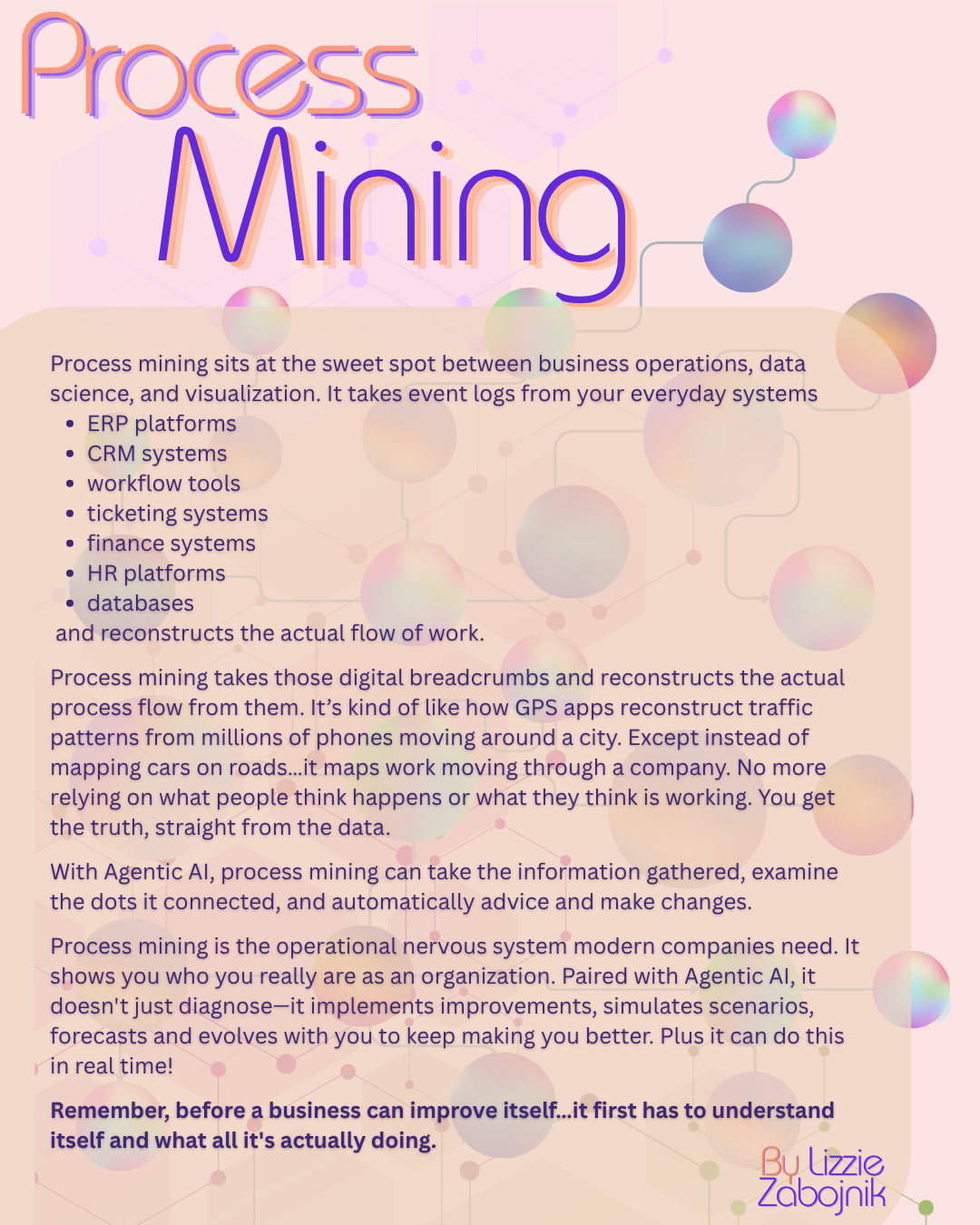
Process mining sits at the sweet spot between business operations, data science, and visualization. It takes event logs from your everyday systems
- ERP platforms
- CRM systems
- workflow tools
- ticketing systems
- finance systems
- HR platforms
- databases
and reconstructs the actual flow of work.
Think of it like this: Every time something happens in your business—an invoice is approved, a support ticket escalates, a package ships, a loan gets reviewed—your systems drop a little data packet with:
- Case ID (e.g., Order #12345)
- Activity name (e.g., "Approve Invoice")
- Timestamp
- Often extras like user, department, cost, or status
Process mining takes those digital breadcrumbs and reconstructs the actual process flow from them. It’s kind of like how GPS apps reconstruct traffic patterns from millions of phones moving around a city. Except instead of mapping cars on roads…it maps work moving through a company. No more relying on what people think happens or what they think is working. You get the truth, straight from the data.
It's the perfect middle child between a static flowchart (visual but fake) and a raw database query (real but overwhelming).
A Quick History: From Academic Nerdery to Enterprise Superpower
It traces back to the late 1990s, with serious roots at Eindhoven University of Technology in the Netherlands. Professor Wil van der Aalst—pretty much the godfather of the field—started exploring ways to extract process models from event data around 1997-2000. Early work at places like IBM Almaden also played a role where a team saw in those days that companies were generating enormous amounts of transactional data from:
- databases
- ERP systems
- banking systems
- manufacturing systems
- IT operations
- supply chain software
IBM Almaden researchers worked on techniques to:
- analyze sequences of events
- identify recurring operational patterns
- detect anomalies
- reconstruct workflow behaviors from logs
- discover inefficiencies hidden in large datasets
- model how complex systems behaved over time
Instead of looking at processes through interviews and planned flowcharts, researchers wanted to extract operational truth directly from data.
At the time, this was a huge shift in thinking! And when computers were still young and way before agentic AI, this type of analysis took a lot of manual work.
Today? It's exploded and automated. We're seeing Object-Centric Process Mining (OCPM) for handling complex, interconnected objects (not just linear cases), heavy AI integration, and now Agentic AI pushing it from passive observation to autonomous optimization.
The Technical Side: How Process Mining Actually Works
The overall flow of how process mining works is straightforward — even if the data engineering behind it can get highly technical.
Usually the process works like this:
1. Event Logs Are Extracted
Data is pulled from source systems like:
- ERP platforms
- CRM systems
- workflow tools
- ticketing platforms
- finance systems
Each event typically contains:
- timestamp
- activity
- case ID
- user or system data

Those logs become the raw material that gets recorded.
2. The Data Gets Cleaned & Normalized
Because real business data is messy.
Different systems often:
- name activities differently
- use inconsistent timestamps
- duplicate records
- track workflows differently
The data has to be standardized before meaningful analysis can happen.
3. Process Discovery Happens
The process mining system analyzes patterns and automatically reconstructs the real workflow map.
Instead of manually drawing processes (like the group at IBM Almaden did), the software discovers them directly from operational data (digitally and live).
- This is where companies often have those:
- “Wait… THAT’S how work actually flows?” moments.
The more processes a company has, the greater chance for more "ah ha" moments.
4. Conformance Checking & Optimization
This is where process mining becomes incredibly powerful.
The software can:
- compare the real process against the intended process
- detect deviations
- identify bottlenecks
- measure efficiency
- recommend improvements based on what it sees
Short Answer, process mining typically performs three major functions:
1.Discovery
- Building the process model from raw event logs.
2.Conformance Checking
- Comparing the real-world process against the intended process.
3.Enhancement
- Improving the process model using timing, frequency, and performance data.
- Some advanced platforms can even simulate process changes before implementation.
- That’s valuable because businesses can test improvements digitally before changing real operations.
- Similar to how pilots train in flight simulators before flying real aircraft with passengers onboard.
Real-World Examples
- Small/Mid-Size Vibes:
- A growing e-commerce company may use process mining to analyze its order-to-cash workflow.
- The company might discover:
- certain orders consistently ship late
- refunds take too long
- customer service tickets spike after shipping delays
- inventory approvals slow fulfillment
- The result with process mining?
- Faster shipping
- Better customer satisfaction
- Lower refund rates
- Happier employees dealing with fewer escalations
Sometimes fixing just a few bottlenecks creates massive gains for smaller companies.
Mid-Size Company Example
- A SaaS company may use process mining on customer onboarding and support workflows.
- The platform might reveal:
- billing-related tickets escalate three times more often
- highly technical issues stall between departments
- engineers spend too much time on repetitive manual tasks
- onboarding flows create customer confusion
- The platform might reveal:
- With process mining insights, the company can:
- redesign workflows
- automate repetitive steps
- reduce response times
- improve customer retention
- improve onboarding experiences
- Saas companies have to adapt quickly to stay competitive and agile to market changes. Any slow processes, gaps between teams, or underutilized communication flows must be identified and resolved quickly.
Manufacturing Example
- A mid-market manufacturer might study procurement and production handoffs.
- Process mining could reveal:
- delays in materials approval
- invoice matching issues
- duplicated manual work
- inefficient supplier approval chains
Even small improvements can dramatically improve production timelines.
Enterprise Example: Healthcare, Banking, or Government
- Large enterprises often have extremely complex workflows involving:
- regulations
- audits
- approvals
- compliance requirements
- multiple disconnected software systems
- A healthcare provider might use process mining to improve patient onboarding and insurance verification.
- A bank may analyze loan approval processes to make the process smoother and faster.
- A government organization may use it to improve citizen services that involve many departments and strict compliance rules.
At enterprise scale, shaving even a few minutes off high-volume workflows can save millions annually.
Enter Agentic AI: From X-Ray to Autopilot
AI is pushing process mining and resource planning into an entirely new era of adaptive operations. Traditional planning methods often rely on static forecasts and manual decision-making, but AI allows organizations to simulate multiple future scenarios in real time and adjust dynamically as conditions change.
Using machine learning, predictive analytics, and real-time monitoring, AI can forecast demand, optimize inventory, improve production scheduling, detect supply chain risks, and automatically recommend resource allocation strategies. Instead of reacting after problems occur, businesses can proactively prepare for disruptions, shifting customer behavior, market volatility, or operational bottlenecks before they become major issues.
Process mining exposes how work actually flows through an organization, while AI analyzes those workflows, predicts future outcomes, and continuously adapts operations based on new data. Together, they create a living operational system capable of learning, forecasting, simulating, and improving itself over time.
Example: Imagine a customer support operation.
- Process mining identifies:
- refund tickets are taking too long
- certain approvals are delayed
- customers escalate complaints around specific topics
- certain procedures slow down ticket resolution times
- An agentic AI system could then:
- automatically gather customer information
- summarize issues in plain language
- prioritize high-risk tickets
- proactively request approvals
- reroute workloads dynamically
- notify managers about bottlenecks
- trigger automations between disconnected systems
- recommend workflow improvements
- Modern AI-driven planning systems can:
- simulate best-case, worst-case, and likely future scenarios
- dynamically reroute workflows during disruptions
- optimize staffing, production, inventory, and logistics
- automate repetitive planning and reporting tasks
- identify inefficiencies and recommend improvements in real time
- continuously update forecasts as conditions change
This shift moves businesses away from rigid planning cycles and toward intelligent, adaptive operations that are faster, more resilient, and far more data-driven in near real time.
In many ways, process mining provides the operational visibility, while AI provides the predictive intelligence and autonomous decision-making needed to turn that visibility into continuous optimization.
Agents in CRM's and Similar Platforms
Many CRM's, like HubSpot, have their own agent built into their platform with access to all your company's data within HubSpot. However, these agents do not perform true process mining. For example, HubSpot agents don't automatically discover and visualize your full process maps from raw event logs like true process mining platforms (Celonis, UiPath Process Mining, Apromore, etc.). They operate within predefined or custom workflows inside the HubSpot ecosystem, mainly around marketing, sales, and service.
Why It Matters (and Why Now)
Businesses usually drown in data but starve for actionable truth. Process mining replaces gut feelings and more limited manually tracking with facts. Add Agentic AI and you get speed—moving quickly from quarterly or weekly reviews to continuous improvement.
In the End
Process mining is the operational nervous system modern companies need. It shows you who you really are as an organization. Paired with Agentic AI, it doesn't just diagnose—it evolves with you to keep making you better.
If your business feels like it's running on a mix of spreadsheets, hope, tribal knowledge, and it spread across multiple platforms and systems... maybe it's time for an X-ray. The digital breadcrumbs are already there. Go mine them.
Remember, before a business can improve itself…it first has to understand itself and what all it's actually doing.