The Integration Revolution
Full article: How Integrations between softwares are Providing Even More Value to Customers Than Ever Before
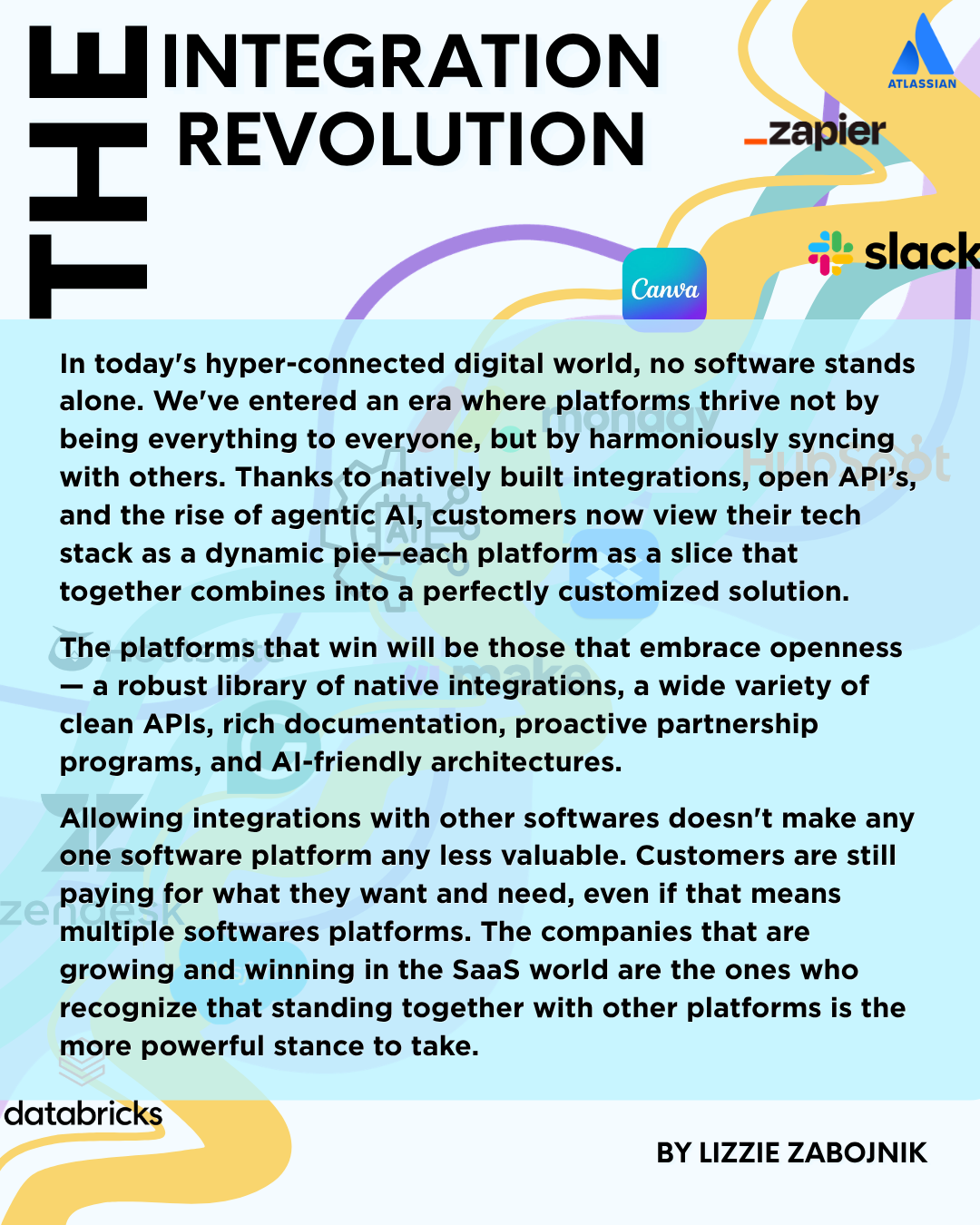
In today's hyper-connected digital world, no software stands alone. The days of buying a single, monolithic program to handle one specific task or type of tasks are fading fast (or already buried). Instead, we've entered an era where platforms thrive not by being everything to everyone, but by harmoniously syncing with others. Thanks to natively built integrations, open API integrations, and the rise of agentic AI, customers now view their tech stack as a dynamic pie—each platform as a slice that together combines into a perfectly customized solution. This shift is exhilarating, empowering, and transforming how businesses and individuals work. While the goal to have everything in one place remains, customers can better do that by the integrations that companies provide and continue to add to their platform.
From Standalone Silos to Interconnected Ecosystems
Long ago in a galaxy far far away, before cloud base software, things were different. You bought software like Microsoft Office or a desktop accounting program, installed it, and that was it. It did "that one thing" exceptionally well (or sometimes not), but expanding its capabilities often meant waiting for the next paid upgrade or switching tools entirely. Customers saw each piece of software as a complete, self-contained solution. If they needed something else, they bought another software and used the two separately. Maybe they manually added information from one to the other to keep them in sync, but the two remained as two distinct solutions.
Fast-forward to now: the narrative has flipped. Software companies are racing to boast about their integration libraries the way restaurants highlight their "farm to table" approach or specials menu. Visit the websites of Monday.com, Asana, Hootsuite, Lucidchart, Slack, Make (formerly Integromat), Canva, Zendesk, and dozens of others, and you'll find lengthy "Integrations" pages that grow weekly. It's no longer about being the best standalone tool—it's about being the best connectable tool.
This isn't just marketing fluff. It's a fundamental reimagining of value.
The API Explosion: Building Bridges, Not Walls
APIs (Application Programming Interfaces) are the Saturn 5 rocket, taking integrations and what softwares can do to a whole new world! They allow platforms to talk to each other seamlessly, exchanging data, triggering actions, and sharing functionality in real time. And the top competing companies are using these to create native integrations where customers can seamlessly and quickly connect different software with almost the click of a button.
- Canva doesn't just let you design stunning graphics—it connects directly to major social media platforms and allows customers to publish posts across networks with a couple of clicks.
- Make acts as a powerful automation hub, weaving Monday.com project boards with Zendesk tickets so customer issues automatically update project statuses and notify the right teams. It can make just about any other integration that you want as well!
- Slack has evolved into a central nervous system for organizations, pulling alerts from monitoring tools, CRM systems, HR platforms, and more, while keeping everyone in the loop without endless email threads.
- Monday has an integrations with almost anything and everyone so you can pull in data from anywhere, organize it, review it, and take actions on anything that you need to.
The result? Customers gain the freedom to mix and match. Marketing teams can live in their favorite design and social tools while sales uses a different CRM, and operations ties it all together. No more forcing everyone into one rigid platform or using multiples independently of each other. Teams pick the best-in-class tools for their needs and connect them effortlessly for other teams to see the way they need to see the data.
Agentic AI: The Smart Glue That Makes It Magical
Now with agentic AI, we can do things that emulate magic in real life. These autonomous AI agents don't just respond to commands and answers to questions but proactively pull, analyze, connect, and act on data across platforms (if allowed). These agents use APIs as their hands and eyes, orchestrating complex workflows that would previously require hours of manual copying, pasting, and context-switching by a human being. But now those humans can "wave a magic wand" and prompt an agent to perform complex tasks in a few minutes!
With an AI agent, pre built in or integrated through an MCP, customers are getting the ability to:
- Build their own customized dashboards based on the data in any platform
- Summarize customer data across all tickets, meetings, and emails
- Analyzes sentiment or priority after analyzing 100's of feature requests
- Send automatic updates regarding almost any software data point/trigger
- Create custom logs for anything companies want to track
- Even create API calls and perform browser actions than normally a user would perform
It feels super sci-fi, but it's reality today. AI isn't just a super smart Google search engine anymore, like ti was when it first came out. It's more of a universal tool that can be used by anyone (even non techy people) to perform actions in software, connect softwares to each other, or pull data out of softwares for custom use, as long as it's connected. Agentic systems reduce manual drudgery dramatically, minimize errors, and unlock insights that siloed data could never reveal. Companies are no longer just selling software; they're selling participation in an intelligent, living ecosystem by integrating with others and implementing AI agents.
Why Customers Are Winning Big
The benefits of this "pieces of the pie" mentality are massive and multifaceted:
- Ultimate Customization: Stitch together the exact features you love. Need advanced analytics from one tool but love the UI of another? Connect them!
- Team Freedom and Adoption: Different departments have different needs. Design teams adore Canva and Figma. Developers love Jira or Linear. Sales thrives on Salesforce or HubSpot. Integrations let everyone use their preferred tools while maintaining company-wide visibility by letting data flow between the different softwares through integrations.
- Feature Extensibility: Instead of waiting (or begging) for a new feature, you can often "add" it by navigating to the software platform's integration library and selecting the integration that you want. With agentic AI, you can now also prompt your agent to fetch the data you need from the platform and build an alert, dashboard, reports...whatever you need.
- Massive Time Savings: Integrations eliminate manual duplicate entries. They speed up communication with auto alerts inside Slack when something is added or edited in the platform. Instead of switching between screens or platforms, you can use an integration to automatically send a social posting, update on a ticket or bug pulse, a new lead, or notification about and invoice processing from the platform you are working in immediately to another. What used to take hours or days of coordination now happens in the background automatically.
- Better Insights and Agility: With data flowing freely between products and platforms along with with broader access/context, agentic AI can spot patterns, predict issues, and suggest optimizations in whatever software you use. Businesses become more responsive and data-driven in a much shorter time frame.
Real-World Momentum
The trend is accelerating. Integration marketplaces are exploding. Platforms like Zapier and Make have democratized automation for non-technical users, while deeper native integrations from the big players ensure reliability at scale. Even enterprise giants are opening up, recognizing that walled gardens limit growth in a connected world.
Startups are especially benefiting. A new project management tool doesn't need to build email marketing or design capabilities from scratch—it can integrate with Mailchimp, Canva, or whatever else the customer already uses. This lowers barriers to entry and accelerates innovation across the board. It also lets companies who are great as what they do be the ones in charge of doing that thing rather than a company having to create everything from scratch and then support everything long term.
Atlassian: A Leader in Open, Connected Platforms
Atlassian has been one of the strongest proponents of this philosophy, particularly in the DevOps space. As quoted on their Open DevOps integrations page, “No single vendor will ever deliver all the tools you need to do DevOps. However your team works, Open DevOps integrates with the tools you have now, and the new tools you’ll inevitably acquire in the future.”
This mindset positions Atlassian as a true leader in building platforms that connect rather than confine. Through Jira Software at the center, Open DevOps creates a seamless experience across diverse toolchains by automatically updating issues with contextual information from integrated tools, reducing context-switching so teams can focus on building great software products. Jira supports over 40 preferred partner apps built to rigorous standards, plus a thriving Marketplace for community-driven integrations, secure OAuth Application Links that embed third-party screens and data directly into Jira, and flexible REST APIs for fully custom connections. Whether linking to GitHub, GitLab, Snyk, or countless others, Atlassian empowers organizations to assemble their ideal DevOps stack—making it a prime example of how modern platforms succeed by becoming essential, interoperable pieces of the customer’s broader pie.
Looking Ahead: A More Intelligent, User-Centric Future
As agentic AI matures, we’ll see even more seamless orchestration. AI agents will handle multi-step processes within and across dozens of platforms with minimal human oversight. Security and governance will evolve alongside (with better permission models and audit trails), ensuring the connection between pieces of the pie ad what AI is doing remain trustworthy.
The platforms that win will be those that embrace openness— a robust library of native integrations, a wide variety of clean APIs, rich documentation, proactive partnership programs, and AI-friendly architectures. Customers will reward those who have flexibility and reliability as well as those who are being truly team oriented in the SaaS world.
Your Slice of the Pie
The software world is no longer a collection of isolated islands and really it hasn't been for the big players for a long time. It’s a vibrant, interconnected marketplace where the best experiences emerge from thoughtful interconnectedness. Native integrations, open APIs, and agentic AI are handing power back to users, letting us build workflows that perfectly fit our unique needs rather than forcing us to adapt to rigid tools or have multiple "master" platforms.
So next time you evaluate a new platform, don’t just ask “What can it do?” Ask “How well does it interconnect with others?” Because in this exciting new era, the strongest solutions aren’t the ones that try to do it all or the ones that try to convince you that what they have is all that you need—they’re the ones that amplify everything else in your stack. This doesn't make any one software platform any less valuable. Customers are still paying for what they want and need, even if that means multiple softwares platforms. But rather than trying to stand alone, the companies that are growing and winning in the SaaS world as the ones that are recognizing that standing together with other platforms is more powerful through integrations and of course agentic AI.
As a customer, the pie is yours to assemble however you like. Dig in—the possibilities have never tasted better!