DevOps: An Example of Better Together
The Revolution That Made Shipping Software Actually Work
There's a before-and-after moment in software history, and its name is DevOps. Before DevOps, shipping software was a blood sport between developers who wanted to move fast to write and test the code and operations teams who wanted to never break things when the code was actually deployed for end users to use. After DevOps, those same people from those two groups started to sit together at the same table to deploy new features, software, and updates and the entire industry accelerated.
However, this was the culmination of decades of frustration, iteration, and a handful of visionaries who realized the real problem wasn't the code – it was the wall between the people writing it and the people running it. A true testament to how departmental walls and narrow processes through only certain people cripple company efficiency.
A Quick Walk Through Methodology History
Waterfall: The Long March (1970s--1990s)
Inspired by manufacturing and construction processes, Waterfall treated software development like building a bridge: gather requirements, create and document design, implement, test, deploy – each phase completed before the next begins. And all this was done with little to no feedback during the process with a "whatever we had in mind in the beginning, that's what we are doing" mindset. Winston Royce actually wrote his 1970 paper as a critique of this model, but the industry adopted it anyway. The result? Projects that took years, gathered dust between phases, and delivered software that was almost obsolete by launch day (of course in the days before the internet, this is kinda understandable). Operations and development barely spoke because they were separate departments. QA was a formality at the end. Changes to software were terrifying events that most dread because everything was interdependent in a very strict manner.
Agile: The Fast Iterators (2001)
Pushing for a way to improve the industry, seventeen developers signed the Agile Manifesto in 2001. They declared that working software beats documentation, customer collaboration beats contract negotiation, and responding to change beats following a plan. Sprints replaced monolithic timelines. Demos replaced specs. Users got features faster. But Agile had a blind spot: it optimized the development (writing the code) loop without necessarily fixing the deployment loop (deploying the code). You could build fast, but you still had to hand the code to operations, who still had their own priorities, tooling, and schedules. The wall was still there – it just got hit more frequently.
Scrum & Kanban: Structure and Flow (2000s--2010s)
Agile spawned frameworks. Scrum gave teams timeboxed sprints (usually 2-week), daily standups, sprint retrospectives, and clear roles. Kanban, borrowed from Toyota's manufacturing system, introduced visual boards and work-in-progress limits: you don't start more work than you can finish. Both dramatically improved team-level predictability and throughput. But they didn't solve the fundamental Dev/Ops divide. Development teams could now ship features every two weeks – and operations teams now had to deploy them every two weeks, often with no automation, no shared tooling, and no shared accountability. This lack of interconnectivity on many level still cause a strain point for many people.
DevOps: The Bridge (2007--present)
The breaking point arrived in 2007. Belgian consultant Patrick Debois, frustrated by the chronic friction between development and operations teams, started looking for a better way. In 2008, he connected with software developer Andrew Shafer over a concept called "Agile Infrastructure," and together they formed the Agile Systems Administration Group.
The spark that lit the movement came in 2009, when Debois watched a livestream of the legendary "10+ Deploys Per Day: Dev and Ops Cooperation at Flickr" presentation by John Allspaw and Paul Hammond at the O'Reilly Velocity Conference. That talk demonstrated what was possible when developers and operations stopped throwing things over the wall to each other and started working as one team. Inspired, Debois launched the first DevOps Days conference in Ghent, Belgium to try to spread this solution to other and make it an industry standard. The movement caught fire. Similar events sprang up worldwide, and "DevOps" entered the tech lingo for good.
What DevOps Actually Is (Hint: It's Not Just Tools)
DevOps is often misunderstood as a toolchain – Jenkins here, Docker there, Kubernetes everywhere. Tools are critical, but DevOps is fundamentally a culture, a set of practices, and a philosophy. The core idea: the people who write the code should own the responsibility for how it runs in production. No more "works on my machine." No more tumbleweed handoffs. No more separation of departments when they are trying to accomplish the same thing. Dev and Ops share goals, share metrics, and share blame in the new world of DevOps.
The proven best practices that define modern DevOps:
- Automation. Automate everything you can – builds, tests, deployments (CI/CD), infrastructure provisioning, configuration management. Automation eliminates manual error, shrinks cycle times, and lets humans focus on problems that actually require human judgment.
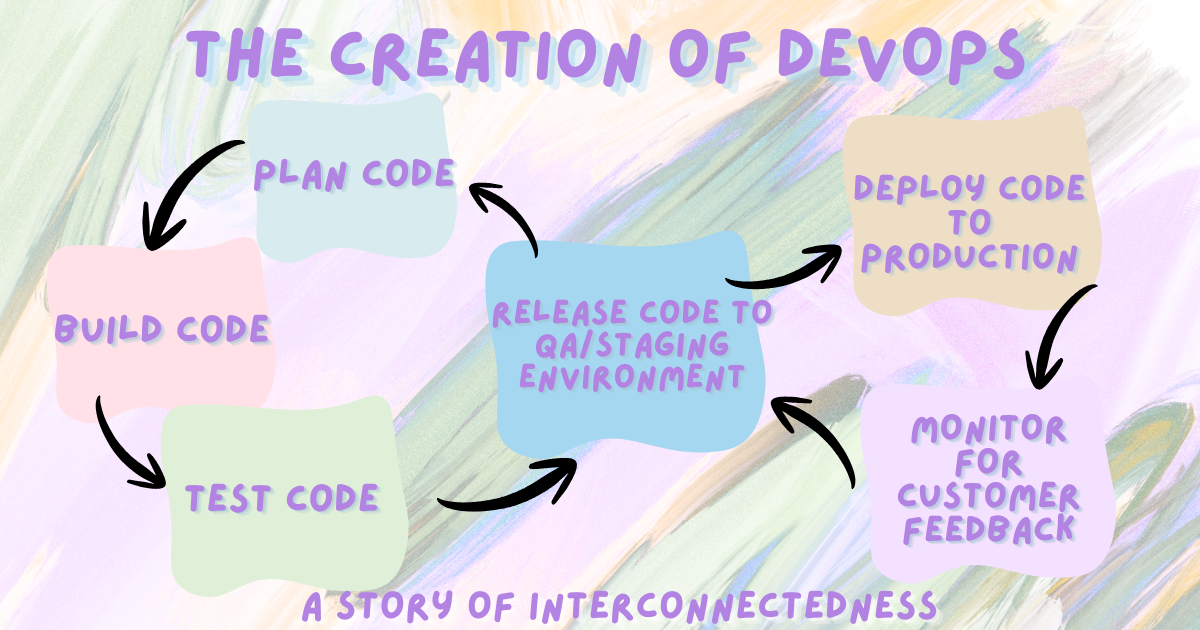
- Continuous Integration & Continuous Delivery (CI/CD). Developers merge code into a shared branch multiple times per day. Automated builds and tests run on every commit, to check the new code before it's merged into the rest of the codebase (CI). Delivery pipelines push verified code to staging and production environments with zero manual intervention (CD).
- Jenkins is a leading open-source automation server explicitly designed to provide Continuous Integration (CI) and Continuous Delivery/Deployment (CD) with every code commit that a developer submits. Other popular options are GitHub Actions and GitLab CI/CD, which can cloud host your source code and better manage CI/CD for you.
- Cloud computing. Cloud platforms provide on-demand, elastic infrastructure. Teams spin up environments in seconds instead of waiting weeks for provisioning tickets. Cloud unifies the platform for developing, testing, and releasing, collapsing the distance between "code works locally" and "code works in production."
- Cloud Providers: AWS, Microsoft Azure, and Google Cloud (GCP) allow you to spin up on-demand VMs and tear them down. Provisioning Tools, such as Terraform or CloudFormation let you codify your infrastructure so you can deploy an identical copy of your stack quickly.
- Containerization. Technologies like Docker and Kubernetes package applications into portable, self-contained units that run identically on a developer's laptop and in production. No more "it worked in dev" surprises. Containers make microservices architectures in software possible and deployments predictable.
- An alternative is Linux System Containers (LXC). While Docker isolates individual applications, LXC isolates entire operating systems. You would use it to test complex, multi-service architectures, init systems (like
systemd), or kernel-level network routing without configuring heavy Virtual Machines (VMs).
- An alternative is Linux System Containers (LXC). While Docker isolates individual applications, LXC isolates entire operating systems. You would use it to test complex, multi-service architectures, init systems (like
- Microservices. Instead of building monolithic applications (where all front end, business code, and database access are kept together on that same server and always deployed together for all updates), teams decompose them into small, independently deployable services. Each service runs in its own process and communicates with others via lightweight APIs. Every team then owns their own service end-to-end – code, deployment, and operations. This reduces coordination overhead and lets teams move at their own pace.
- Example:
- Catalog Service: Manages product details, inventory, and images.
- Cart Service: Tracks the items a user adds or removes from their shopping basket.
- Payment Service: Processes secure transactions and interfaces with banking APIs.
- Notification Service: Sends email/SMS updates once the order is placed.
- Example:
- Continuous Everything. Beyond CI/CD, DevOps embraces continuous testing, continuous monitoring, continuous feedback, and continuous operations. Insights from one stage flow seamlessly into the next, creating an ecosystem of relentless improvement, which is why it's a framework that operates well with the agile methodology.
The Dev/Ops Divide That Started It All
To understand why DevOps matters so much, you have to understand the pain it eliminated. Before DevOps, the typical workflow looked like this:
- Development pushed for continuous updates -- new features, bug fixes, changes -- as fast as possible.
- Operations tried to limit releases because they were responsible for system stability and uptime. Every change was a risk.
- There was no automated, clearly defined process for handing off code from dev to ops.
- Developers wrote code without fully understanding where or how it would be deployed, often passing along poorly documented deployment guides.
- Operations received code they didn't fully understand, struggled with unclear directions, and bounced it back to developers when things broke.
- Server errors triggered blame games that toxified team culture.
The result was months of delay, fried nerves, and software that barely worked by the time it reached users. DevOps didn't just streamline this process -- it burned down the wall and rebuilt the workflow from scratch.
The Core Benefits of DevOps
Speed. When deployment pipelines are automated and teams share ownership, releases go from quarterly events to daily -- even hourly -- non-events. Netflix deploys thousands of times per day. Amazon deploys every 11.7 seconds on average.
Reliability. CI/CD, automated testing, and infrastructure-as-code mean every change is verified, tracked, and rollback-ready. When things break, the blast radius is small and the recovery is fast.
Collaboration. DevOps replaces blame with shared accountability. Developers see production logs. Operations have input into architecture. Everyone can see the same dashboards, the same metrics, the same truth and they communicate about it regularly.
Scale. Containerization and cloud infrastructure let teams scale services up or down in response to demand without manual intervention. Microservices let teams scale the parts of their system that need it, not the whole monolith (the whole darn thing).
Companies That Prove DevOps Works
Netflix -- The streaming giant is arguably the most famous DevOps story on the planet. Netflix pioneered the "build it, run it" culture where development teams are responsible for their own code in production. Their Simian Army (Chaos Monkey, Latency Monkey, etc.) intentionally introduces failures into production to verify system resilience. Netflix engineers deploy thousands of times per day across a microservices architecture serving 280M+ subscribers in 190+ countries. Their DevOps culture is so deeply embedded that "Chaos Engineering" became an entire discipline adopted across the industry.
Amazon -- Amazon's deployment pipeline is legendary. The company deploys code every 11.7 seconds on average, powered by their internally built CI/CD system (dubbed "Apollo" and "Pipelines"). Amazon's "two-pizza team" structure -- small, autonomous teams that own a service end-to-end -- is a DevOps organizational pattern that's been widely adopted. Their development of AWS itself is a DevOps product: they built the infrastructure automation they needed, then turned it into a $100B+ business that the entire industry now runs on.
Etsy -- Etsy is one of the earliest and most celebrated DevOps adopters. In 2009, they were deploying twice a week with painful, manual processes and frequent outages. By 2015, they were deploying 50+ times per day with near-zero downtime. They open-sourced their deployment tool, Deployinator, and their monitoring platform, StatsD, which became foundational tools in the DevOps ecosystem. Etsy's transformation proved that DevOps wasn't just for tech giants -- it worked for mid-size companies too.
Target -- Target's DevOps transformation is one of the most compelling enterprise stories. Starting around 2014, the retail giant rebuilt its engineering culture around DevOps principles. They adopted open-source tools, created internal platforms for CI/CD, and shifted to a "you build it, you run it" model. Their engineers went from deploying every few weeks to deploying hundreds of times per day. Target proved that DevOps works at scale in traditional enterprise environments -- not just in Silicon Valley startups.
Google – Google pioneered many of the practices that DevOps formalized, including Site Reliability Engineering (SRE). Their error budgets, blameless postmortems, and automated canary deployments set the standard for the industry. Google's Borg container orchestration system (the predecessor to Kubernetes) ran millions of containers years before Docker made containerization mainstream. Their DORA metrics framework – measuring deployment frequency, lead time for changes, time to restore service, and change failure rate – became the gold standard for evaluating DevOps performance.
The New Chapter: Agentic AI and the Future of DevOps
If DevOps automated the pipeline, Agentic AI is automating the judgement calls inside the pipeline. The latest evolution of DevOps isn't just about faster deploys -- it's about smarter deploys, smarter monitoring, smarter incident response, and smarter code. AI agents aren't replacing DevOps engineers. They're giving every DevOps engineer a team of tireless, context-aware assistants that never sleep.
Here's how agentic AI is reshaping DevOps right now:
1. Infrastructure That Writes and Heals Itself
Terraform and Infrastructure-as-Code (which allow new servers to spins up automatically based on code instead of manually in order to maintain a good server infrastructure for your code) gave DevOps teams reproducible environments. Agentic AI takes it further by generating the IaC (Infrastructure as Code) itself. Tools like GitHub Copilot for Azure and Pulumi AI let engineers describe infrastructure in natural language – "I need a three-tier web app with auto-scaling, a managed database, and CDN caching" – and the agent generates the configuration, provisions the resources, and validates the setup (servers, networks, and databases). When a container crashes at 2 AM, AI agents can detect the failure, analyze the logs, scale up a replacement, and alert a human only if the issue falls outside known remediation patterns. At Google, SRE teams use AI-assisted incident triage that automatically correlates alerts across hundreds of microservices, cutting mean time to detection from hours to minutes.
2. Smarter CI/CD Pipelines
Traditional CI/CD pipelines (Continuous Integration and Continuous Delivery/Deployment) in the development cycle are deterministic: they run the same steps every time, whether the change is a one-line CSS (Cascading Style Sheets) tweak or a major database migration. Agentic AI introduces conditional intelligence. Tools like Harness's AI DevOps Assistant and GitLab Duo analyze the content of each commit and dynamically adjust the pipeline -- skipping unnecessary test suites for trivial changes, triggering extended performance benchmarks for database-related commits, and flagging security-sensitive changes for deeper scanning. At Microsoft, AI-powered pipeline optimization reduced average build times by routing jobs to the right runners, caching intelligently, and predicting which tests are likely to fail based on historical data -- before the tests even run.
3. AI-Powered Observability and Root Cause Analysis
DevOps made monitoring ubiquitous. Agentic AI makes monitoring understandable. Platforms like Datadog's Watchdog, Dynatrace Davis AI, and Splunk's AIOps don't just detect anomalies -- they explain them. When a latency spike hits, an AI agent traces it through distributed traces, correlates it with a recent deployment, identifies the specific service and code change responsible, and suggests a rollback or fix -- all before a human has finished reading the Slack alert. At Amazon, AI-driven observability tools process billions of telemetry data points daily, automatically surfacing the root cause of issues that would have taken a team of engineers hours to diagnose manually.
4. Automated Bug Discovery and Remediation
This is where it gets really interesting for DevOps culture. Agentic AI tools like Amazon CodeGuru, Snyk's AI-powered vulnerability scanning, and GitHub Advanced Security don't just flag static analysis issues -- they generate the fix. An agent identifies a security vulnerability in a pull request, writes the patch, opens a PR with the fix, and runs the CI pipeline to verify it. At Meta, internal AI tools automatically detect and fix bugs in production configuration files, reducing the number of human-touched config changes by over 50%. The DevOps feedback loop, which used to be "detect -> page -> diagnose -> fix -> deploy," is compressing to "detect -> agent fixes -> verify -> deploy."
5. Intelligent Test Generation and Maintenance
Test automation has always been a DevOps cornerstone, but writing and maintaining tests is labor-intensive. Agentic AI changes the economics. Tools like Testim, Mabl, and Playwright's codegen can generate test suites by watching user interactions, analyzing application behavior, and producing tests that adapt when the UI changes. When a test breaks because a button moved, an AI agent can determine whether the test is outdated or the feature is actually broken -- and either fix the test automatically or flag the regression. At Spotify, AI-assisted test maintenance reduced flaky test rates by automatically quarantining and rerunning unstable tests, keeping the CI signal clean and maintaining deployment velocity.
6. Shift-Left Security (DevSecOps) at AI Speed
DevSecOps made security everyone's responsibility. Agentic AI makes it instant. Snyk, Checkmarx, and Semgrep now use AI agents that don't just scan code for known vulnerability patterns -- they understand context. An agent can tell the difference between a SQL injection vulnerability in a public-facing API vs. an internal utility that's low risk. It can prioritize fixes, generate patches, and even open pull requests with the security fix already applied. At Netflix, automated security scanning powered by AI agents runs on every commit, catching dependency vulnerabilities and misconfigurations before code reaches staging -- not after it reaches production.
The Bottom Line
Waterfall taught us planning. Agile taught us iteration. Scrum and Kanban taught us flow. DevOps taught us the lesson that was always hiding in plain sight: the person who writes the code should be responsible for what happens to it after it ships. Agentic AI is now teaching us that responsibility doesn't have to mean burnout -- it can mean partnership with machines that handle the repetitive, the diagnostic, and the predictable, freeing humans to focus on the architectural, the creative, and the edge cases no agent has seen yet.
When you break down the wall between development and operations, automate everything you can, give teams end-to-end ownership, and augment them with AI agents that never sleep -- you don't just ship faster. You ship better.
The companies that have embraced DevOps most fully aren't just deploying more often. They're recovering from failures faster, collaborating better, scaling effortlessly, and building products that users actually love. That's not a methodology. That's a competitive advantage. With agentic AI in the mix, it's one that compounds over time, automatically, throttle up what development and operation teams can do in a short time in a big way!
Want to go deeper? Check out the DevOps.com evolution of DevOps for the full origin story, Atlassian's DevOps guide for practices and tutorials, and the DORA State of DevOps Report for the data behind the movement.