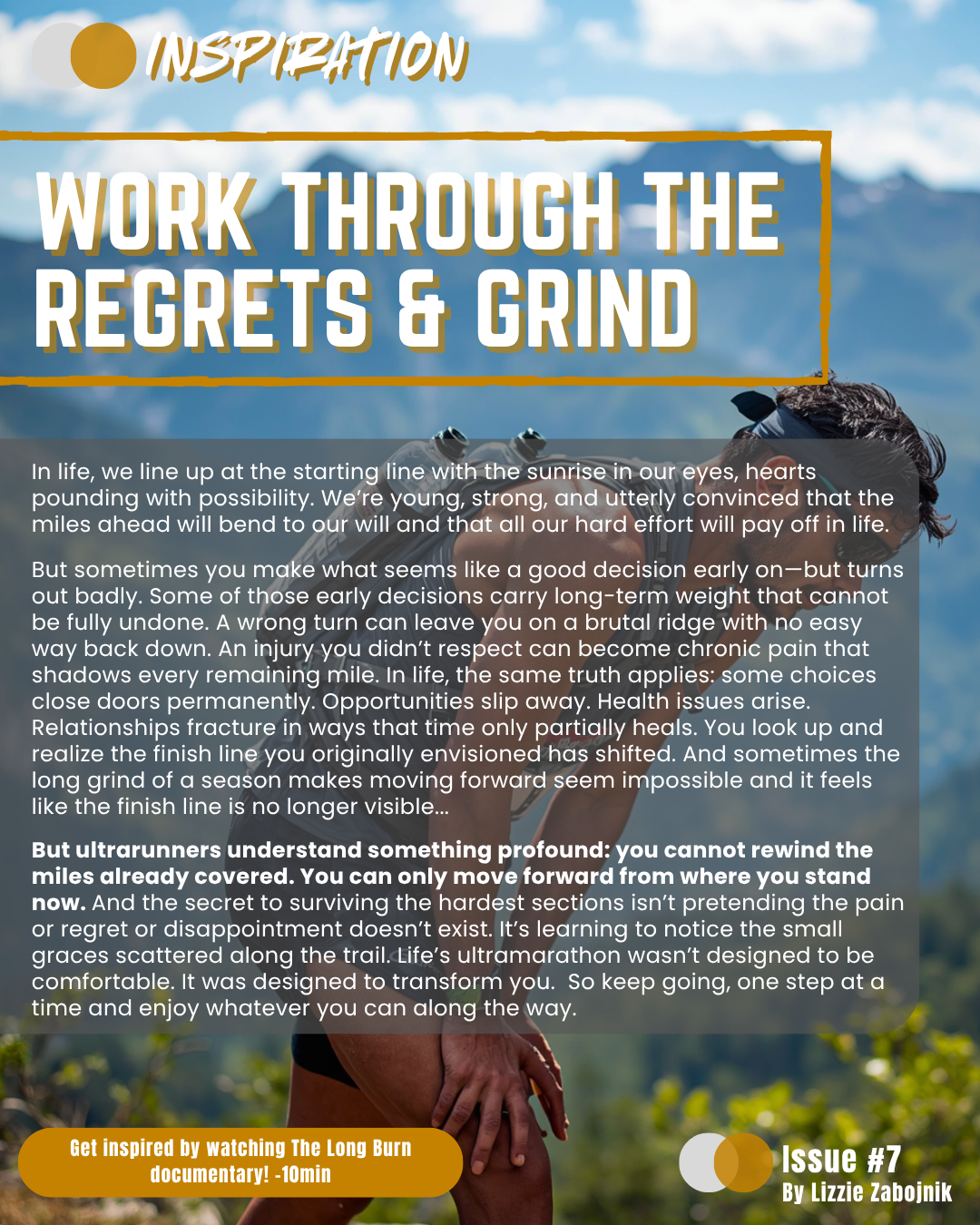
Inspiration 7 | Work Through the Regrets & Grind
Full article
We line up at the starting line with the sunrise in our eyes, hearts pounding with possibility. We’re young, strong, and utterly convinced that the miles ahead will bend to our will and that all our hard work will pay off. The training plan is perfect, the gear is shiny, and the finish line—whatever dream we’ve pinned on it—feels close enough to touch. This is the beginning of the ultramarathon we call life.
Then the miles start adding up.
The early energy that carried you through the first 10, 20, even 50 miles begins to fade. The real world creeps in like a sudden headwind. Work deadlines replace training schedules. Responsibilities stack higher than the elevation gain on the course profile. Your pace slows. The optimism that once felt bulletproof now feels… negotiable.
And just like in any true ultramarathon, "good" choices early on, don't always play out like you expected or hoped.
Sometimes you make what seems like a good decision early on— taking a certain trail fork, pushing too hard through an aid station, or ignoring a minor warning sign in your body. In life, these moments look like choosing (or staying in) a career path, entering (or staying in) a particular relationship, moving to a new city, or taking on a financial commitment that felt manageable at the time. At mile 20, the choice feels minor. By mile 80, its consequences have compounded.
Some of those early decisions carry long-term weight that cannot be fully undone. A wrong turn can leave you on a brutal ridge with no easy way back down. An injury you didn’t respect can become chronic pain that shadows every remaining mile. In life, the same truth applies: some choices close doors permanently. Opportunities slip away. Health issues arise. Relationships fracture in ways that time only partially heals. You look up and realize the finish line you originally envisioned has shifted—or perhaps it’s no longer visible at all.
In those moments, the temptation to quit is overwhelming. The voice in your head grows loud: This wasn’t supposed to happen. I can’t fix this. Maybe I should just stop.
But ultrarunners understand something profound: you cannot rewind the miles already covered.
You can only move forward from where you stand now. You assess the damage, adjust your strategy, lighten your pack where possible, and keep putting one foot in front of the other. You do what can be done—perhaps rerouting, accepting a slower pace, or redefining what “finishing” even means. The race doesn’t care about your original plan. It only asks if you’re willing to continue with the reality in front of you.
The grinding pain starts to set in.
As you keep moving, your feet develop blisters that refuse to heal. The constant ache in your lower back becomes an unwelcome companion. Your legs grow heavier with every step, and the horizon stubbornly refuses to reveal the finish line. Some stretches of the trail feel endless—monotonous, painful, demoralizing.
In these moments, quitting doesn’t just sound reasonable; it sounds rational.Why keep going? you ask yourself. I’ve already given so much. Maybe this isn’t my race.
But something stops you from stepping off the course. Maybe it’s the months (or years) of preparation. Maybe it’s quiet pride. Maybe it’s the deep knowledge that walking away now would haunt you more than the pain of continuing. So you do the only thing you can: you lift one foot and place it in front of the other. Again. And again.
And then, when you least expect it, something shifts.
A second wind arrives—not always dramatic, but real. Or perhaps you don’t get a second wind at all. Instead, you simply keep moving until the miles themselves carry you across the line. Sometimes you realize this particular ultra isn’t the one you were meant to finish, and you graciously DNF (do not finish)—knowing you’ll chase that finish line again next year, wiser and better prepared.
The secret to surviving the hardest sections isn’t pretending the pain or regret or disappointment doesn’t exist. It’s learning to notice the small graces scattered along the trail.
That cold, fresh creek you stumble upon when your mouth feels like cotton? Savor it. The unexpected field of wildflowers lighting up a barren stretch of trail? Stop for a moment and take in the view. Discover the forgotten energy bar at the bottom of your pack and celebrate like you’ve won the lottery. And when a friend shows up to pace you—someone who’s willing to run beside you through the darkness—notice their smile. Let it carry you.
These small wins aren’t distractions from the suffering. They are the reason we keep going. They remind us that even on the hardest miles, beauty, relief, and connection still exist.
Life’s ultramarathon wasn’t designed to be comfortable. It was designed to transform you.
The version of you who crosses the finish line (or learns to start again) is fundamentally different from the wide-eyed runner who lined up at dawn. Stronger. Humbler. More resilient. More grateful.
So if you’re in one of those brutal middle miles right now—where every step hurts and the finish feels impossibly far—know this:
You’re not alone.
The trail is long, but it’s also breathtaking.
And you are still moving.
Put one foot in front of the other.
Take the salt pill.
Eat the damn energy bar.
Smile back at your pacer.
The miles that break you are the same ones that remake you. Keep going. The best part of the story is still ahead—somewhere beyond the next aid station, past the next ridge, after the next long night.
You’ve got this.
One step at a time.
Get inspired by watching The Long Burn documentary! - under 10 min video