Complex Concepts Made Simple | NASA Code Standards Made Simple
When you’re writing code solo, it’s easy to treat style and structure as personal preference. But the moment a second developer enters the picture, those preferences turn into friction. This friction can be and will be felt by your customers using the product. Without shared standards, even simple tasks—like reading, debugging, or extending code—can become unnecessarily slow and error-prone.
Code standards act as a common language. They define how things are named, structured, formatted, and documented, so that anyone on the team can quickly understand what’s happening without decoding someone else’s habits. Consistency reduces cognitive load, which means developers can focus on solving problems instead of interpreting code.
Beyond readability, standards are critical for long-term stability. Projects evolve, teams change, and codebases grow. What made sense to one developer six months ago may not be obvious to someone new today. Clear conventions—like consistent naming, modular design, proper commenting, and predictable patterns—help ensure the code remains maintainable and adaptable over time.
The good news is that many solid standards already exist. Style guides, linting tools, and widely accepted design principles give teams a strong foundation to build on. Adhering to these isn’t about limiting creativity—it’s about creating clarity and reliability.
In the end, good code isn’t just about working today. It’s about still making sense tomorrow, to anyone who needs to work with it.
Top 10 General Code Standards
1. Consistent Naming Conventions
Use clear, predictable names for variables, functions, and classes. Pick a style (camelCase, PascalCase, snake_case) and apply it consistently. Names should describe intent, not just type.
2. Code Formatting & Linting
Automate formatting with tools (like Prettier or ESLint for JavaScript, or equivalents in your stack). This removes style debates and keeps code uniform across the team.
3. Modular, Single-Responsibility Design
Each function, class, or service should do one thing well. Smaller, focused components are easier to test, reuse, and maintain.
4. Clear Project Structure
Organize files and folders in a predictable way (e.g., by feature or domain). New developers should be able to navigate the repo without a map.
5. Documentation Standards
Document why, not just what. Include README files, API docs, and meaningful comments where logic isn’t obvious. Good SaaS teams treat documentation as part of the product.
6. Version Control Best Practices
Use a consistent branching strategy (like GitFlow or trunk-based development). Write clear commit messages and keep pull requests focused and reviewable.
7. Code Reviews as a Requirement
No code goes to production without at least one other set of eyes. Reviews help catch bugs, enforce standards, and spread knowledge across the team.
8. Automated Testing
Maintain a healthy mix of unit, integration, and (when needed) end-to-end tests. Tests should be reliable and run automatically in your pipeline.
9. Error Handling & Logging Standards
Handle errors consistently and log meaningful information. In SaaS, observability is critical—your logs often are your debugging process in production.
10. Security & Configuration Practices
Never hardcode secrets. Use environment variables and secure storage. Follow least-privilege principles and regularly audit dependencies.
These standards aren’t about being rigid—they’re about reducing chaos as your product and team scale. The real win is alignment: when everyone writes code the same way, your system becomes easier to build, safer to change, and far more resilient over time. If your SaaS team doesn’t agree on standards early, you’ll eventually pay for it in bugs, slow onboarding, and fragile releases.
So have standards and document them so everyone can be on the same page!


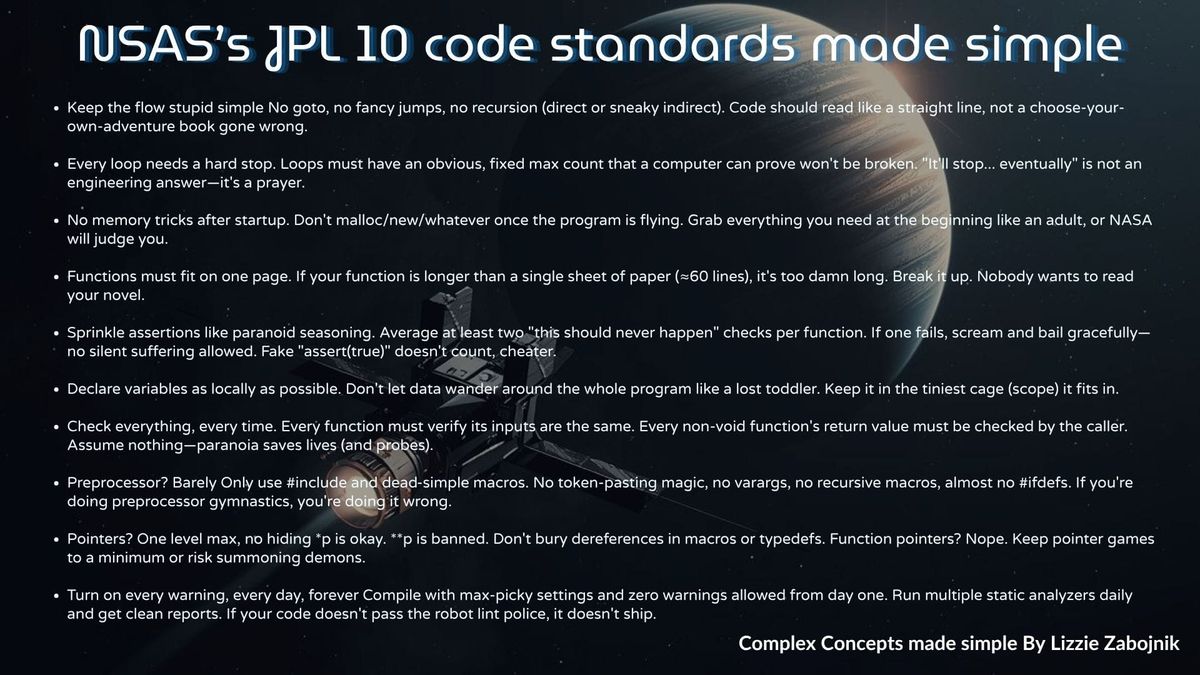
NASA Code Standards Simplified