Don't Let AI Connections Replace Human Connectedness
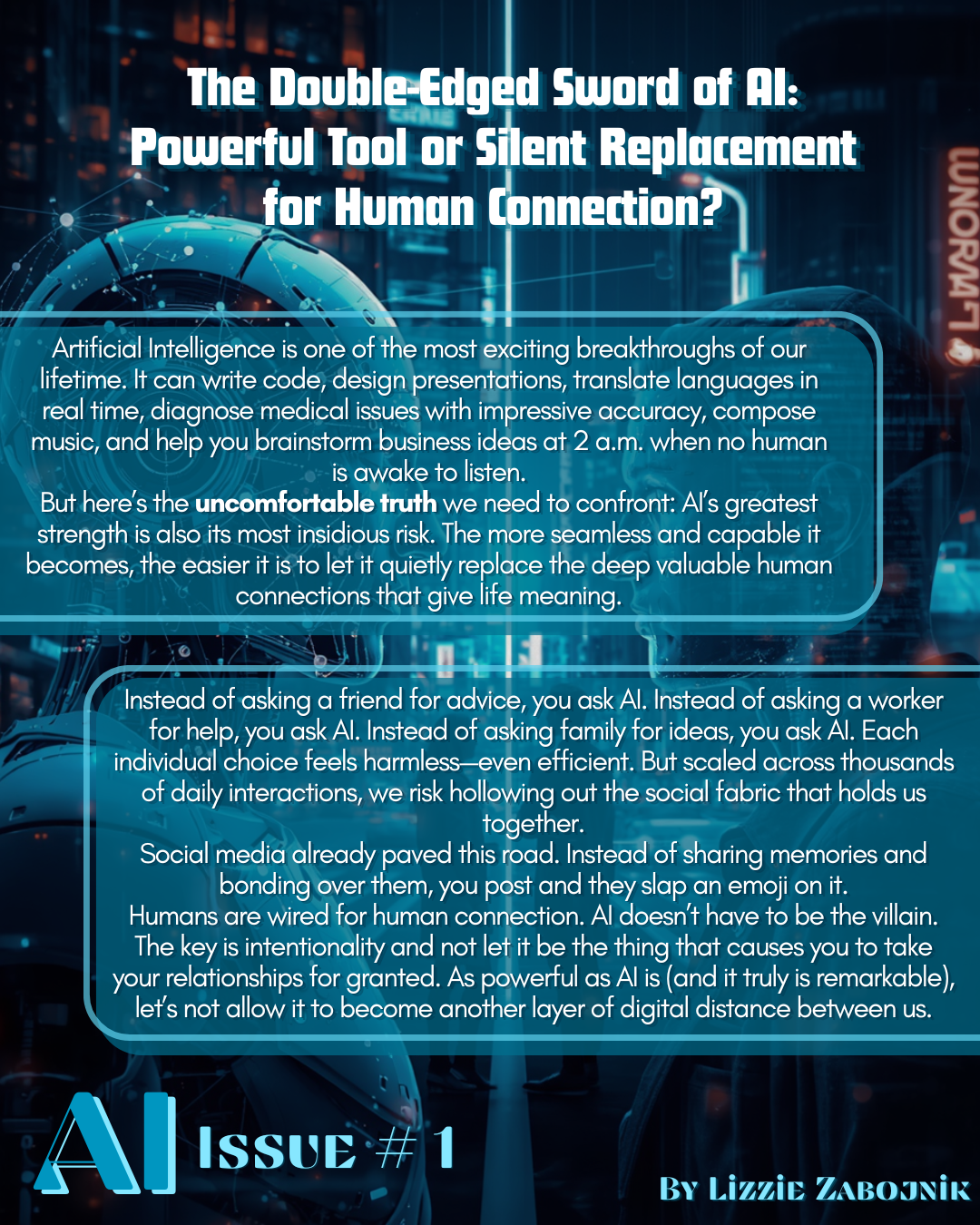
Full article: The Double-Edged Sword of AI: Powerful Tool or Silent Replacement for Human Connection?
Artificial Intelligence is one of the most exciting breakthroughs of our lifetime. It can write code, design presentations, translate languages in real time, diagnose medical issues with impressive accuracy, compose music, and help you brainstorm business ideas at 2 a.m. when no human is awake to listen. Tools like Grok (and its cousins at OpenAI, Anthropic, and beyond) make knowledge more accessible than ever, lower barriers for creators, boost productivity, and even provide companionship for those who feel isolated. In many ways, AI is a genuine force for good—democratizing expertise and freeing humans from drudgery so we can focus on higher-value work and creativity.
But here’s the uncomfortable truth we need to confront: AI’s greatest strength is also its most insidious risk. The more seamless and capable it becomes, the easier it is to let it quietly replace the deep valuable human connections that give life meaning.
When Convenience Becomes Substitution
Think about everyday scenarios that used to require reaching out to another person:
- Stuck on a work problem? Instead of walking over to a coworker’s desk or hopping on a quick call to get their perspective (and maybe chat about their weekend), you prompt an AI. You get a polished answer in seconds. No small talk, no relationship-building, no reciprocity.
- Feeling down or needing advice on a personal dilemma? Rather than calling a friend who knows your history and cares about you, you vent to a chatbot that never gets tired, never judges, and never needs support in return.
- Planning a trip or learning a new skill? AI can give you itineraries, recipes, workout plans, or book recommendations instantly. Why bother asking your well-traveled friend who’s been dying to share stories?
Each individual choice feels harmless—even efficient. But scaled across thousands of daily interactions, we risk hollowing out the social fabric that holds us together.
Social media already paved this road. Remember when you came back from a vacation and friends would gather to see your photos? You’d tell stories, laugh about the disasters, and strengthen bonds through shared experience. Now? You post the highlight reel on Instagram or Facebook, everyone scrolls past and drops a heart or fire emoji, and the conversation largely ends there. The technology that promised to “connect” us often delivers shallow validation instead of real engagement. Depression and anxiety rates have climbed significantly over the past two decades alongside this shift—especially among younger people who’ve grown up with smartphones and social platforms as primary social outlets.
Adding ever-more-capable AI into this mix risks accelerating the trend. If your AI companion is always available, infinitely patient, and customized to your preferences, why invest the effort in maintaining real friendships that sometimes involve conflict, inconvenience, or emotional labor?
The Mental Health Cost
Humans are wired for human connection. Evolutionary biology and decades of psychological research show that strong social relationships are one of the strongest predictors of long-term happiness, resilience, and even physical health. Loneliness, by contrast, is linked to higher risks of depression, anxiety, heart disease, and premature death—comparable in impact to smoking.
We don’t need another technology that makes isolation feel comfortable. The convenience of AI can become a crutch that lets us take our friends, family, and coworkers for granted. “I don’t need to bother them—I’ll just ask Grok/Claude/ChatGPT.” Over time, this erodes empathy muscles, reduces opportunities for vulnerability, and diminishes the depth of our relationships.
Using AI Wisely: Augment, Don’t Replace
AI doesn’t have to be the villain. The key is intentionality:
- Use AI as a starting point, not the final stop. Generate ideas with AI, then discuss and refine them with real humans.
- Protect sacred spaces for connection. Keep certain conversations—deep personal advice, creative brainstorming with colleagues, catching up with friends—human-first.
- Be deliberate about outreach. After asking AI for travel tips, text your friend who loves that destination anyway. Share the AI output and ask what they think.
- Notice the trade-offs. If you find yourself preferring AI responses over human ones because they’re faster or less emotionally taxing, that’s a warning sign worth paying attention to.
AI will continue getting better at mimicking empathy, humor, and support. That’s impressive engineering, not a substitute for the real thing. A friend who remembers your struggles from last year, a coworker who celebrates your win with genuine enthusiasm, or a family member whose hug can’t be replicated—these have irreplaceable value.
As powerful as AI is (and it truly is remarkable), let’s not allow it to become another layer of digital distance between us. Use it to enhance your life and capabilities. But keep showing up for the people around you. Call your friend. Grab coffee with your coworker. Share the unfiltered vacation stories in person.
The technology is incredible. The humans in your life are irreplaceable. Don’t let convenience convince you otherwise.