Complex Concept Made SImple | Reverse Proxy
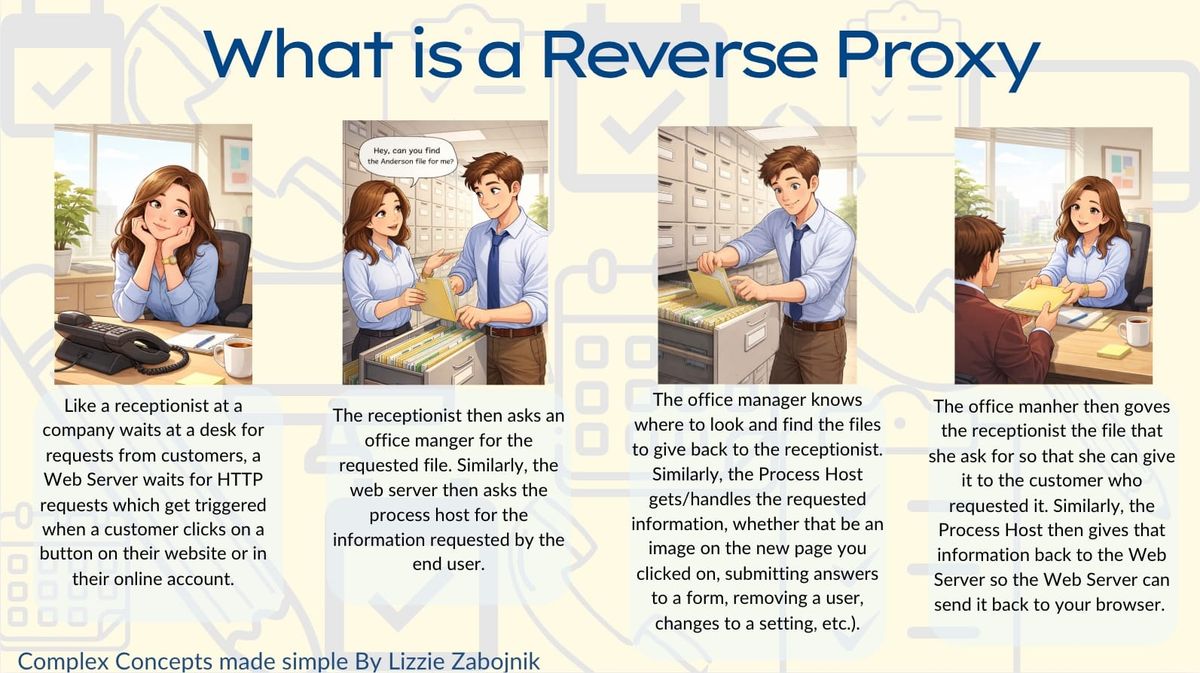
What is a Reverse Proxy (and Why You Probably Need One)
If you're running a website or online application, you've likely heard the term "reverse proxy." Many people confuse it with a regular (forward) proxy, but the two serve very different purposes. A reverse proxy acts as an intermediary that sits in front of your web servers, handling incoming client requests and forwarding them to your backend application servers.
Think of it like a smart receptionist for your website. Clients (browsers, mobile apps, APIs) talk to the reverse proxy, which then communicates with your actual servers on their behalf and returns the response to the user. Popular options include Nginx, Apache, HAProxy, Traefik, and cloud services like AWS CloudFront, Cloudflare, or Azure Application Gateway.
Why Reverse Proxies Are Important
Using a reverse proxy delivers several critical benefits:
- Security: It hides your origin servers' real IP addresses and architecture. Attackers can't easily target your backend directly. You can implement SSL/TLS termination (handling HTTPS in one place), Web Application Firewall (WAF) rules, rate limiting, and IP blocking at the proxy layer.
- Performance: Reverse proxies can cache static content, compress responses, and serve files directly, reducing load on your application servers. This leads to faster page loads and better user experience.
- Load Balancing: If you have multiple backend servers, the proxy can intelligently distribute traffic across them, preventing any single server from becoming overwhelmed.
- Scalability and Reliability: Easier to add or remove backend servers without downtime. Features like health checks automatically route traffic away from unhealthy instances.
- Simplified Management: Centralizes logging, monitoring, URL rewriting, and routing (e.g., directing /api to one service and /blog to another).
What Happens If You Don't Use One?
Exposing your application servers directly to the internet is risky and inefficient:
- Increased Attack Surface: Your servers are fully visible. DDoS attacks, vulnerability exploits, and brute-force attempts hit your app layer directly, often overwhelming it.
- Performance Bottlenecks: No built-in caching or efficient connection handling (e.g., handling thousands of keep-alive connections). Your app servers spend more time on overhead instead of running business logic.
- Harder Scaling: Adding capacity or doing blue-green deployments becomes more complex and error-prone.
- Certificate and Security Management Nightmares: Managing HTTPS certificates across multiple servers is painful. A single misconfiguration can expose sensitive data.
- Single Points of Failure: Without load balancing, one slow or crashed server can take down your entire service for users.
Many small sites start without a reverse proxy and get away with it—until traffic spikes or a security incident occurs. At that point, retrofitting one under pressure is stressful and costly.
The Bottom Line
A reverse proxy is one of the highest-ROI infrastructure decisions you can make. Even for simple personal projects or early-stage startups, setting up Nginx or using a CDN with proxy features (like Cloudflare) provides immediate security and performance wins.
If you're hosting online software or a website today, ask yourself: Are my origin servers directly reachable from the internet? If the answer is yes, consider adding a reverse proxy—your future self (and your users) will thank you.