When the Stakes Are High, So Is the Need for Rigorous Team QA Testing: Lessons from the Apollo Program and the Saturn V Rocket
Full article
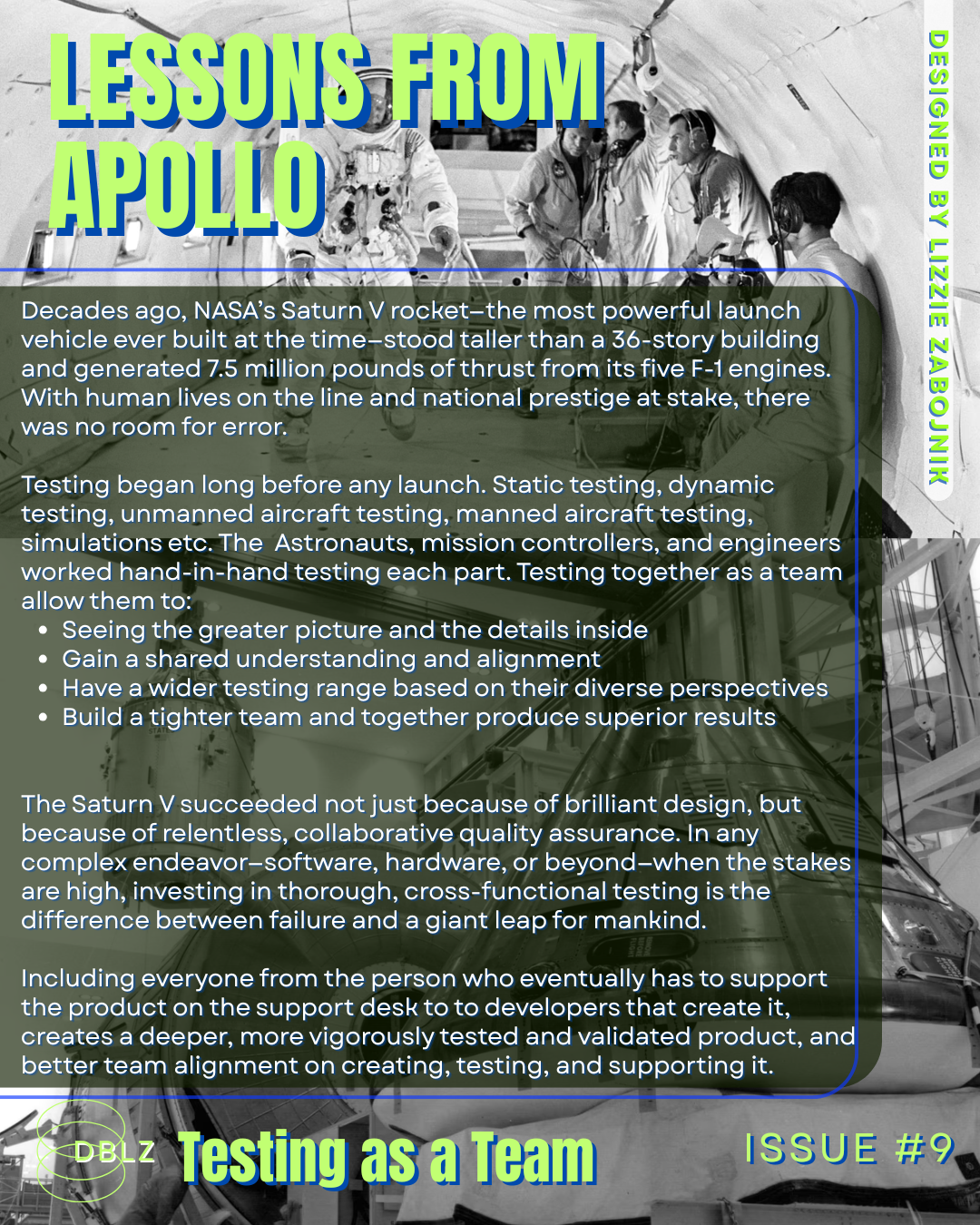
In the race to the Moon, NASA faced one of humanity’s most audacious engineering challenges. The Saturn V rocket—the most powerful launch vehicle ever built at the time—stood taller than a 36-story building and generated 7.5 million pounds of thrust from its five F-1 engines. With human lives on the line and national prestige at stake, there was no room for error. Extensive testing by engineers, mission controllers, and astronauts ensured that every component worked flawlessly.
A Comprehensive Testing Regime
Testing began long before any launch. Engineers conducted static fire tests on individual stages, firing engines for full durations on test stands (such as at NASA’s Stennis Space Center and Marshall Space Flight Center) to verify thrust, steering, and structural integrity. Dynamic tests simulated flight vibrations, bending, and stresses on the full stack.
Uncrewed "all-up" test flights followed: Apollo 4 (1967) and Apollo 6 (1968) put the complete three-stage Saturn V through its paces, validating stage separations, engine restarts, and overall performance in real flight conditions. These tests revealed issues (like pogo oscillations and engine problems on Apollo 6) that were quickly addressed.
Astronauts, mission controllers, and engineers worked hand-in-hand. Astronauts trained in simulators and reviewed procedures, providing critical human-factor insights. Mission controllers in Houston practiced real-time troubleshooting. Engineers from multiple contractors (Boeing for the first stage, North American for the second, etc.) and NASA teams collaborated on integration tests, countdown simulations, and system checks.
The Power of Cross-Departmental, Collaborative Testing
High-stakes projects like Apollo demonstrate why group QA testing across departments is invaluable:
- Seeing the Greater Picture and the Details Inside: Collaborative testing lets everyone zoom out to understand how systems interconnect (e.g., how first-stage separation affects the entire vehicle) while diving deep into specifics like fuel plumbing or guidance computers. No single team could grasp the full complexity alone.
- Shared Understanding and Alignment: When astronauts, controllers, and engineers test together, they build a common perspective. Everyone operates from the same verified knowledge base, reducing miscommunication during the actual mission.
- Wider Testing Range and Diverse Perspectives: Different experts bring unique viewpoints. Engineers might catch material fatigue issues, controllers identify procedural gaps, and astronauts flag usability concerns in high-G environments. This diversity uncovers problems that siloed testing would miss.
- Team Building and Superior Results: Joint testing fosters trust and camaraderie. The Apollo teams became a tight-knit group united by shared purpose. The outcome? A rocket with a near-perfect record that successfully sent 24 astronauts toward the Moon.
The Saturn V succeeded not just because of brilliant design, but because of relentless, collaborative quality assurance. In any complex endeavor—software, hardware, or beyond—when the stakes are high, investing in thorough, cross-functional testing is the difference between failure and a giant leap for mankind.
What lessons from Apollo can you apply to your own high-stakes projects? The principles remain timeless.