CO2 Levels in Buildings and Space Crafts
Years ago, while overseeing the installation and programming of hundreds of thermostats across large school districts and mega churches, I regularly met teachers and facilities workers who were deeply concerned about “fresh air.” Sensors in classrooms and large gathering spaces would climb into the low thousands of parts per million (ppm) of CO₂. People saw a number in the 1,000–2,000 range maybe even 4,500, compared it with outdoor air at roughly 400 ppm, and concluded the building was about to become a gas chamber. Their concern was understandable—elevated indoor CO₂ is a decent proxy for ventilation rates and can correlate with stuffiness or reduced cognitive performance—but in nearly every commercial building with functioning HVAC, those levels stay comically far below any actual danger limit.
OSHA’s permissible exposure limit is 5,000 ppm as an eight-hour time-weighted average, with a short-term exposure limit around 30,000 ppm. The Immediately Dangerous to Life or Health value sits at 40,000 ppm. Typical well-ventilated classrooms and assembly spaces simply do not approach these figures. Outdoor air dampers, exhaust systems, people moving in and out of the spaces etc and the sheer volume of the space dilute the CO₂ exhaled by occupants. Even in a packed room, hitting 5,000 ppm for hours is uncommon; nearing 30,000 ppm under normal operating conditions is effectively impossible. The building would have to be sealed tighter than a spacecraft with no ventilation at all.
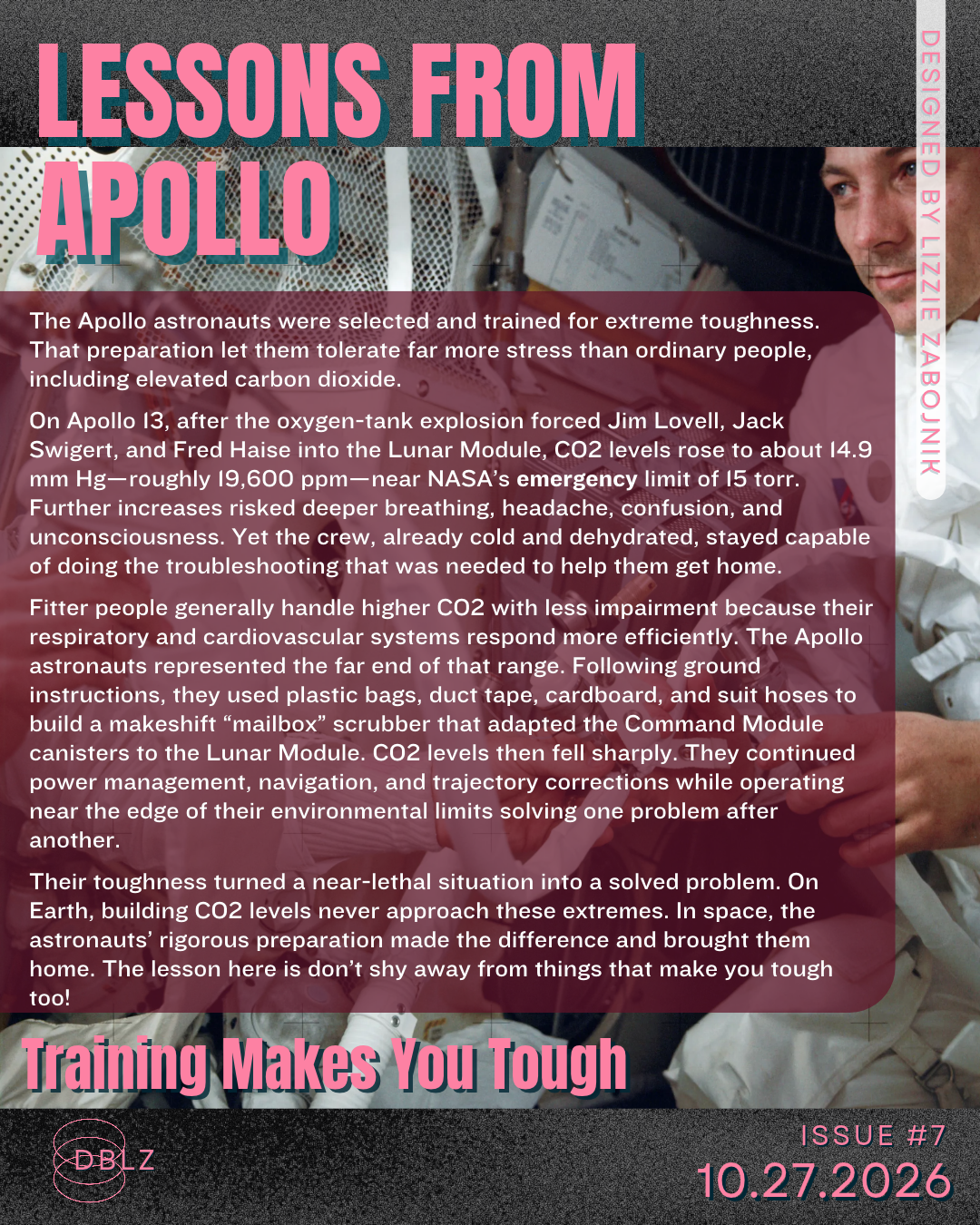
The crazy thing is that the three Apollo Astronauts on Apollo 13 were in a spacecraft that did reach the danger limit, even higher in fact. After the oxygen-tank explosion forced the crew—Jim Lovell, Jack Swigert, and Fred Haise—into the Lunar Module as a lifeboat, the LM’s lithium-hydroxide canisters were not sized for three men over the multi-day return. Sensors showed carbon dioxide partial pressure climbing to about 14.9 mm Hg, roughly 19,600 ppm. NASA’s emergency limit for the program had been set near 15 torr (about 20,000 ppm). Continued rise would have brought deeper breathing, headache, confusion, and eventually the risk of unconsciousness as acid-base balance and respiratory drive were overwhelmed.
The fact that they were able to still work, troubleshoot, and think strategically after days of lack of sleep, lack of food, and in near freezing conditions with high CO2 levels speaks says a lot about these men. This a great example where training matters. The physical fitness and conditioning that these men went through made them tough enough to handle this near deadly situation. Fitter individuals often tolerate higher concentrations of CO2 with less impairment before symptoms become limiting. This is not an invitation to ignore ventilation, but it helps explain how these men were able to still function even though they were past the danger limit.
The three astronauts trained were used to meeting extraordinary standards and intense training from their flight-testing days in the military and they continued that while in the Apollo program. They remained capable of precise work even under the harsh conditions of trying to live in a broken spaceship with the pressure that they were 1,000's of miles away from help. Following detailed instructions from the ground, they used plastic bags, duct tape, cardboard from flight-plan covers, and suit hoses to adapt the square Command Module canisters to the round LM system—the improvised “mailbox” scrubber. Once in place, CO₂ levels fell sharply. They continued other high-stakes tasks—power management, navigation, and trajectory corrections—while cold, dehydrated, and operating near the edge of the environmental limits they had trained to handle. The men of Apollo 13 demonstrated that rigorous mental and physical preparation can keep people functional and effective even when physiological stress is elevated.
So unless you are going to space, forget to bring a backup filter, and then experience a huge technical failure that strands you in a tin can with limited life support, you can relax on Earth knowing that the CO₂ level will never hit the danger line. In ordinary buildings we correctly manage for comfort and long-term performance well below occupational limits. As Tom Hanks’ character Jim Lovell says in Apollo 13 once the makeshift scrubber is finally in place: “Just breathe normal, fellas.”