The Power of Guidelines for Agentic AI: Precision Guidance for Powerful Systems
Full article with specific example
In the rapidly evolving world of agentic AI—autonomous systems capable of complex, multi-step reasoning and tool use—consistency is everything. Without clear, structured instructions, even the most capable models can produce variable outputs, overlook edge cases, or fail to align with organizational standards. This is where guidelines become indispensable.
Why Create Guidelines for AI Agents?
Guidelines serve as a reliable reference framework that an agent can consult for recurring, high-stakes tasks. They encode best practices, enforce methodical processes, and reduce hallucinations or incomplete reasoning.
Key benefits include:
- Consistency: Every analysis follows the same rigorous steps, producing predictable, high-quality outputs.
- Accuracy and Thoroughness: By mandating evidence collection, root cause linkage, and risk assessment, guidelines minimize oversights.
- Efficiency: Agents spend less time figuring out how to approach a problem and more time executing.
- Knowledge Transfer and Onboarding: Guidelines capture institutional expertise that one employee can give to another.
- Auditability and Safety: They create traceable reasoning chains and help prevent agents from hallucinating or going rouge.
- Continuous Improvement: Guidelines can be versioned and refined based on outcomes.
A particularly important use case arises when granting agents access to sensitive data and systems. Many teams connect agents to Jira accounts for ticket management, Monday.com boards for project tracking, Zendesk or HubSpot for customer support data, and even a copy of the up-to-date source code repository.
Security considerations are critical here. Always provide a read-only or limited-permission copy of the source code rather than direct access to the live production repository. A snapshot or mirrored copy is significantly safer: if the agent accidentally goes rogue, hallucinates harmful commands, or deviates from its instructions, the damage is contained to the copy rather than risking the real codebase, live customer data, or production systems.
In these high-trust scenarios, a single long, specific prompt is rarely enough. Agents need guidelines—persistent, referenceable playbooks—to stay firmly between the guardrails and do exactly what is intended, nothing more. Guidelines act as a repeatable operating manual that prevents scope creep, enforces security protocols (e.g., “never modify live data,” “always log actions,” “flag any access outside approved systems”), and maintains compliance with data privacy rules.
One of the greatest practical benefits of a well-written guideline is that it functions like giving the agent a really long, complex, and highly specific prompt every single time—without you having to rewrite it for each request or hoping the model perfectly recalls prior instructions. Even though modern agents have strong context retention, relying solely on conversation history is still a gamble. A dedicated guideline document that the agent can explicitly reference ensures reliability across sessions, tools, and evolving tasks.
Common Types of Guidelines for Agentic AI
Organizations typically create guidelines for repetitive, high-value domains. The most common include:
- Bug Triage and Resolution: Analyzing reports, tracing code, proposing fixes, and assessing impact.
- Code Review and Refactoring: Standards for evaluating pull requests and suggesting improvements.
- Customer Support Automation: Handling inquiries with proper escalation and tone.
- Data Analysis and Reporting: Cleaning datasets, generating insights, and visualizing results.
- Content Generation and Review: Enforcing brand voice, SEO, and compliance.
- Incident Response and Monitoring: Triaging alerts and post-mortems.
- Testing and QA Protocols: Coverage requirements and automation strategies.
These guidelines are often formatted as step-by-step playbooks with templates, checklists, and output structures.
Example: Comprehensive Bug Triage Guideline
Software teams deal with a constant stream of customer-reported bugs. These reports vary widely in quality, often including incomplete steps to reproduce (STR), screenshots, videos, and varying levels of urgency. Even with a structured process, evaluating them by "human means" is subjective, slow, and error-prone—especially high pace and/or hectic work environments.
In addition, these bug report affect different layers of data, some the UI (the front end that the user interacts with), some the database (the backend where all customer data is stored), and some the business code (the source code that creates the software on the backend) or a mixture. Sometimes the more layers of the data that the issues affects, the longer it takes a developer to fix and the higher the probability of that it could introduce other bugs, even though measure are taken to try to prevent that. When those bugs are related to third party integrations, the complexity level rises even more and require even more development work.
Many companies and teams using agentic AI have already or are now using an agentic to help verify, analyze, prioritize, and assist with bug reports and the code fixes that goes along with them.
However, when handing this work to an agentic AI that has access to your Jira/Zendesk tickets and a copy of the codebase, a long, detailed guideline is highly recommended. A specific, step by step of what to do and what not to do is crucial, especially when you need the agent to do the same thing every time with consistency. The guideline should include the full workflow—reviewing bug reports, tracing affected code, root cause analysis, proposing code changes, estimating dev time, planning QA tests, and assessing impact. This delivers a clear direction for your agent to go in, at the lighting speed that is does, without you having to manually type out the thing. Instead, with just a simple prompt, your agent can evaluate the guideline, look at your specific ask in the prompt, and get to work. The guide more value than just a generic prompt or an ad-hoc agent (designed to collaborate with other agents or humans on the fly, without prior coordination, communication, or pre-programming).
Here is a complete, production-ready example of a guideline for an agentic AI handling customer-reported software bugs:
Guideline for Agentic AI Bug Triage & Fix Proposal
This guideline ensures consistent, thorough, accurate, and safe analysis of customer-reported bugs. The agent must follow every step sequentially, document evidence at each stage, and flag uncertainties or insufficient information explicitly. Prioritize minimal, targeted changes that fix the root cause without introducing regressions.
General Principles (Apply to All Steps)
- Evidence-based: Cite specific quotes from the bug report, line numbers/files from code, timestamps in videos, or visual details from screenshots. Never speculate without backing.
- Reproducibility: Always attempt to mentally or (if tools allow) simulate the STR. Note if STR is incomplete or environment-specific (browser, device, user role, data state, API version, etc.).
- Scope: Identify affected components precisely (frontend, backend API endpoint, controller, service layer, job/queue, database schema/query, etc.).
- Context awareness: Consider codebase architecture, recent changes (via git blame/log if available), dependencies, deployment environment, user permissions/tenancy, data volumes, and concurrency.
- Safety first: Flag security, data loss, performance, or compliance risks. Prefer non-breaking changes; suggest deprecation paths or feature flags if needed.
- Clarity & Structure: Use numbered sections mirroring the 7 steps. Include "Evidence Summary", "Assumptions", "Uncertainties/Risks of Analysis", and "Recommended Next Steps" in the final output.
- Tools Usage: Leverage available search/grep, code navigation, file readers, etc. For videos/screenshots, describe key frames precisely.
- Iteration: If information is missing, explicitly request clarification.
1. Review Written Reports, Screenshots, Steps to Reproduce (STR), and Videos
- Parse structured elements:
- Symptoms: Exact error messages, unexpected behavior, UI glitches, performance issues.
- STR: Numbered steps, preconditions (login state, data setup, sequence of actions), reproduction rate (always/sometimes).
- Expected vs Actual results.
- Environment: Browser/version, OS/device, account type (admin/user), app version/build, network conditions.
- Attachments: Timestamps, sequences in videos; annotations or highlighted areas in screenshots; error logs or console output.
- Identify patterns: Affected users (segment: all, specific roles, regions, large accounts), frequency, business impact (e.g., blocks checkout, data corruption).
- Edge cases from report: Time of day, concurrent actions, specific input data (special characters, large files, null values), previous actions in session.
- Visual/Behavioral Analysis:
- Screenshots: UI layout, error modals, missing elements, incorrect values, styling issues.
- Videos: Timing of failure, user interactions leading up to it, network tab behavior (if shown), console errors.
- Severity classification: Critical (data loss, security), High (core feature broken), Medium, Low. Note workarounds mentioned.
- Output subsection: "Bug Summary" with bullet points + "Reproduction Confidence" (High/Medium/Low) and any gaps.
2. Locate Exact Affected Code
- Systematic search:
- Keyword grep for error strings, endpoint paths, function/variable names from STR or errors.
- Trace API flows: Request handlers → Controllers → Services → Jobs/Queues → Repositories/DB queries → External calls.
- Database: Schema, migrations, ORM models, queries (raw SQL or query builders), indexes/triggers.
- Frontend (if relevant): Components, API client calls, state management, rendering logic.
- Supporting code: Validation rules, middleware, auth/permissions, caching, logging, rate limiting, background jobs triggered by the flow.
- Cross-references: Call graphs, imports/dependencies, configuration files (env, feature flags), tests covering the area.
- Recent changes: Check git history for the files/modules.
- Multi-component bugs: Identify primary vs secondary (e.g., backend bug manifesting in UI).
- Output: List of exact file paths, class/method names, line ranges, with brief justification for relevance. Highlight the "smoking gun" sections.
3. Root Cause Analysis (Logical Statement)
- Causal chain: "The bug occurs because [specific code/logic] does X when input Y arrives under condition Z, contrary to expected behavior W (per spec or intended design)."
- Why it exists:
- Missing validation, incorrect assumption about data/state, off-by-one, race condition, unhandled exception path, type mismatch, deprecated API usage, schema drift, logic inversion, missing transaction/atomicity.
- Environmental: Browser-specific, timezone, encoding, permission bypass.
- Regression: Recent change introduced it.
- Evidence linkage: Tie directly to code snippets + report details (e.g., "STR step 3 triggers this query which returns null, causing...").
- Alternative causes ruled out: Briefly note why it's not caching, network, or frontend-only.
- Depth: Consider downstream effects and why it slipped through existing tests.
- Output: One clear, concise paragraph + supporting evidence bullets. Rate confidence (High/Medium/Low) and explain why.
4. Propose Specific Code Changes
- Minimal & Targeted: Provide pseudo-diff or exact code snippets for changes in controllers, services, jobs, DB (migrations/queries), API request/response handling.
- Details to include:
- File + line changes.
- New logic (conditions, error handling, retries).
- Data model updates (if schema change: migration script).
- API contract impacts (request/response fields, versioning).
- Backward compatibility: Feature flags, versioned endpoints, data migration steps.
- Related changes: Logging improvements, metrics, tests.
- Security/Performance: Sanitization, indexing, async handling.
- Implementation notes: Order of changes, prerequisites (e.g., DB migration first), rollback plan.
- Alternatives: Mention if a simpler workaround exists vs. proper fix.
- Output: Numbered changes with rationale and code examples.
5. Time Estimate for Developer Implementation
- Breakdown:
- Investigation/Understanding: X hours.
- Coding changes: Y hours.
- Writing/updating tests: Z hours.
- Refactoring if needed, migration, review prep.
- Factors considered: Complexity of change (lines touched, components), developer familiarity, test coverage existing, deployment pipeline, review cycles.
- Total estimate: Optimistic / Realistic / Pessimistic ranges (e.g., 4-8 developer-hours). Assume mid-level engineer.
- Dependencies: Team availability, other PRs, QA environment.
- Output: Clear total with breakdown and confidence.
6. QA Tests
For each test:
- Type: Unit, Integration, E2E, Manual, Performance, Security.
- Detailed steps: Numbered, reproducible (setup, actions, assertions).
- Expected outcome.
- Estimated time: For execution (e.g., 10 mins).
- Agent vs Human: Agent-automatable (unit/integration with mocks) vs. Requires human (UI/UX, video verification, exploratory, real-device).
- Coverage:
- Happy path + STR reproduction (fixed).
- Edge cases (nulls, max values, concurrency, different users/roles).
- Regression suite for touched modules.
- Post-change monitoring (logs, metrics).
- Automation: Suggest additions to CI/CD.
- Output: Table or numbered list with columns: Test ID/Name | Steps | Time | Owner (Agent/Human) | Priority.
7. Impact & Risk Assessment
- Scope of change: Files/modules affected, blast radius (one endpoint vs. core service vs. DB-wide).
- Risks:
- Regressions in related flows.
- Performance degradation, increased latency/DB load.
- Data integrity/migration issues.
- Security (new attack vectors).
- Compatibility (older clients, mobile apps).
- Downtime or deployment complexity.
- What to watch for: Specific logs/metrics, smoke tests post-deploy, rollback triggers.
- Mitigations: Feature flags, canary releases, monitoring alerts, staged rollout.
- Business impact: Users affected post-fix, communication needed.
- Output: Risk level (Low/Med/High) per category + overall + monitoring recommendations.
Final Output Template & Best Practices
In order to create a successful guideline for an agent to use for evaluating bug reports and suggesting solutions, it highly recommended that it has the following:
- Executive Summary: Tell the agent that they must read the bug title, evaluate severity, suggest a root cause one-liner, rate how easy/impactful the fix is, estimate total dev time, estimate total QA time, and evaluate overall risk of implementing the code fix.
- Full sections 1-7. Spell out for it what it needs to do for each major step.
- Appendix: Give it the right access to the right tools or anything that might help it accomplish what the guideline spells out for it such as code snippets, test plans, open questions to think through.
- Consistency checks: Tell the agent that they should self-review output against this guideline before finalizing or posting updates anywhere such as Jira or Monday.com.
- Escalation: Explain in your guide that for ambiguous/high-risk bugs, it needs to suggest human review or pair programming in order to implement the best solution.
- Learning: Tell it that after each resolution (bug fix), if there are any other tasks you want it to do such as creating note for future (update tests, docs, or patterns).
Additional considerations across all steps:
- Compliance/Legal: PII, GDPR, accessibility.
- Documentation: Update comments, Swagger/OpenAPI, user-facing help.
- Scalability: Handle growing data/users.
- Metrics for success: Bug fixed, no new issues, test coverage increased.
- Version control: Branch naming, commit messages, PR (pull request) description template.
This guideline promotes thoroughness while keeping outputs actionable and developer-friendly (since that is the intended audience with this agent and guideline). Although all guideline for agents should be reviewed and refined periodically based on how the agent performs the tasks in the guidelines.
Bottom Line
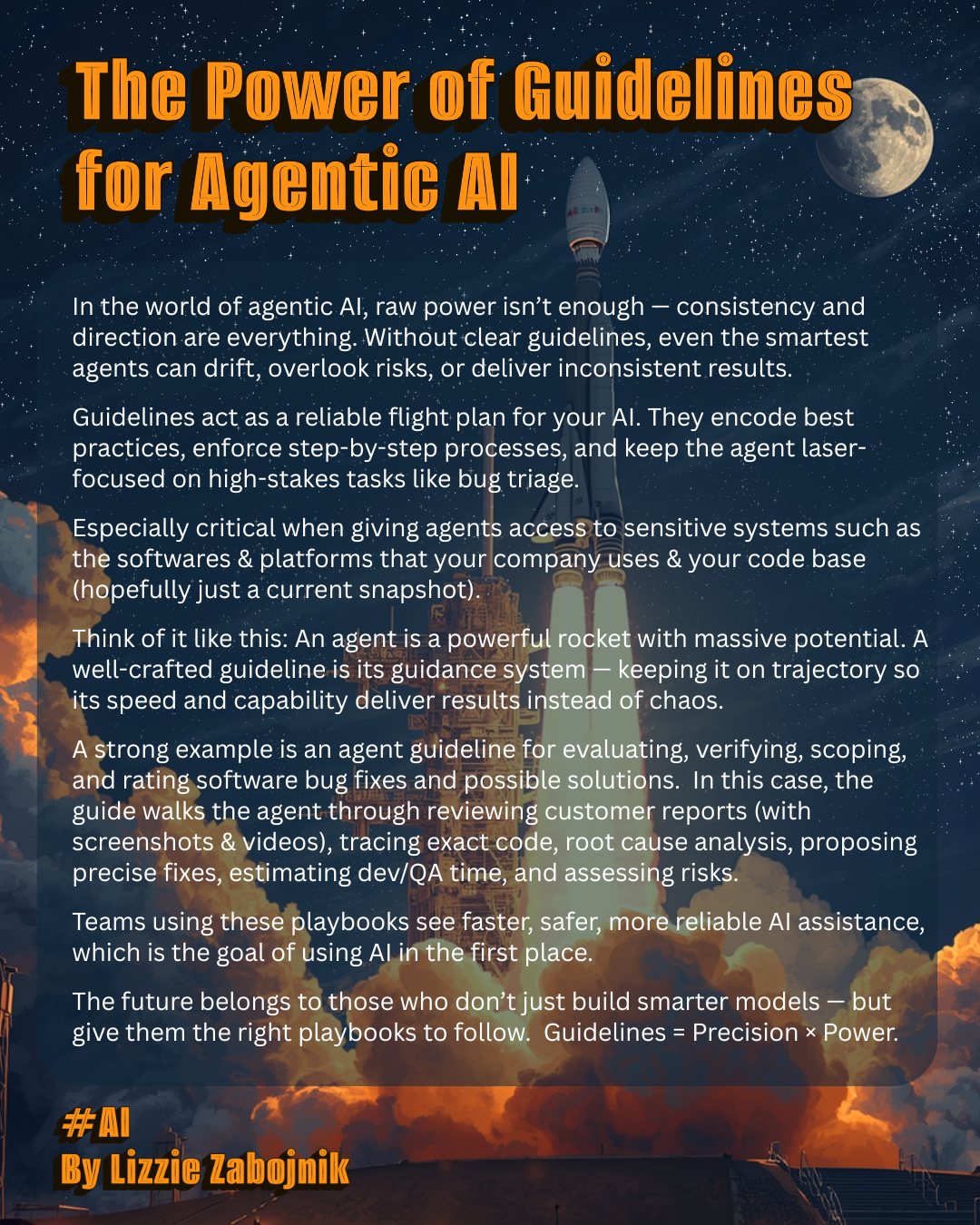
Creating well-crafted guidelines is one of the more important activities when deploying agentic AI, especially when granting access to sensitive tools and data you and your company uses. They bridge the gap between general intelligence and domain-specific excellence while providing essential guardrails that a one-off prompt cannot reliably deliver.
Directing an agent with a guideline is like directing a rocket ship with a proper flight plan. The rocket (the agent) has immense power and capability—it can carry a large payload, travel great distances, and help us discover and achieve exciting new things at incredible speed. But if it gets off course even slightly, the consequences can be swift and severe. A well-designed guideline serves as the guidance system that keeps the agent precisely on trajectory, ensuring its power is aimed discreetly and correctly toward the intended destination.
As AI agents take on more responsibility in engineering, support, and operations, investing in a library of such guidelines—combined with secure practices like using data copies—will separate high-performing teams from the rest. Start simple, iterate based on real outcomes, and watch your AI workflows become more reliable, scalable, secure, and aligned with business needs.
The future of agentic work isn’t just about building smarter models—it’s about giving them the right playbooks to follow. While the rocket has the ability to take a large payload, go great distances, and help us discover lots of new and exciting things, if it gets off course... well you know.