The 3 Stages of Using AI in Program Development
The Evolution of Developer-AI Collaboration: From Prompting to Agentic Engineering
The way developers work with AI has changed dramatically in just a few years. What started as simple Q&A has matured into a powerful, integrated partnership that accelerates development while keeping humans firmly in control.
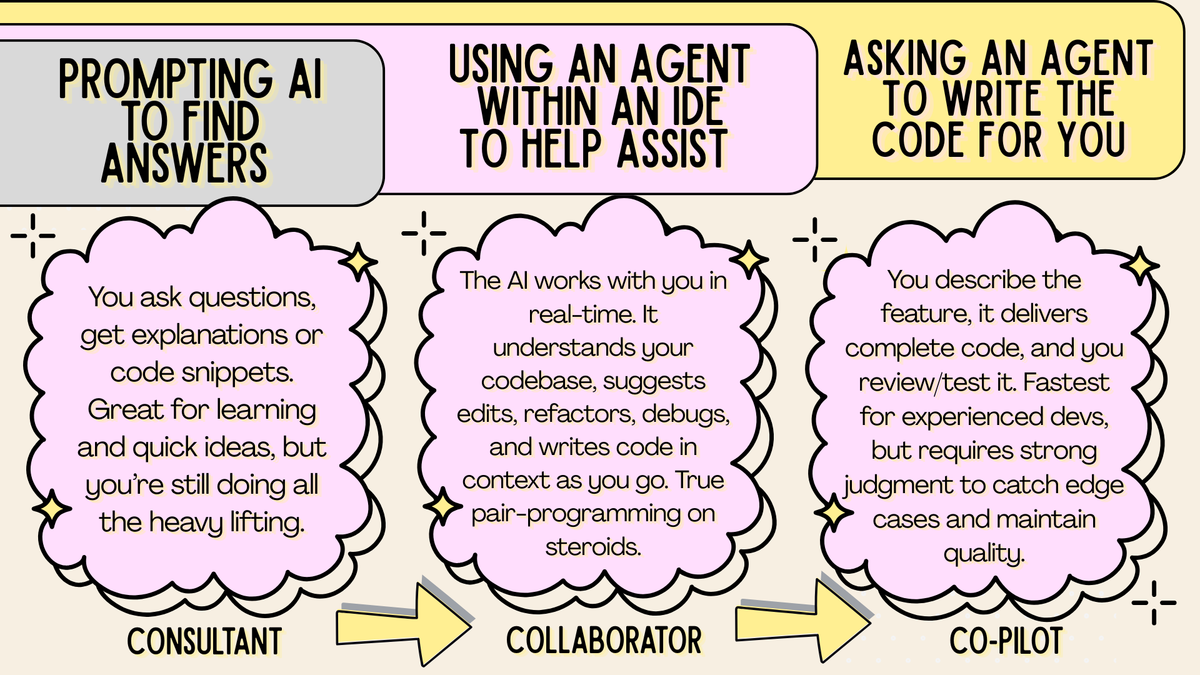
Phase 1: Prompting for Answers
Early on, developers treated AI like a super-smart search engine. They’d open ChatGPT or similar tools and ask:
"How do I handle authentication in Next.js?" or "Explain this React hook error."
This was incredibly useful for learning and quick solutions, but it still required the developer to manually implement, test, and integrate every piece of advice.
Phase 2: Agents Inside the IDE
The next leap came with AI agents embedded directly in the IDE (VS Code, Cursor, JetBrains, etc.). Tools like GitHub Copilot, Continue.dev, or Cursor now understand your entire codebase in context.
Instead of switching tabs, you highlight code and say, “Refactor this function for better performance” or “Add error handling here.” The agent suggests edits in real time, explains its reasoning, and works alongside you like a highly skilled pair programmer.
Phase 3: Full Agentic Code Generation + Human Oversight
Today’s most powerful workflow goes further. Developers describe a feature or bug fix in plain English:
"Add user profile editing with validation and optimistic updates."
The agent generates complete, production-ready code. The developer then reviews it carefully — this human oversight step remains critical.
The Complete Modern Development Loop
Once the code looks good, a developer can:
- Local Validation: Run a build on their machine to catch syntax errors, type issues, and basic failures.
- Local Integration: Merge the new code into their local copy of the source code.
- Developer Environment Deployment: Push the changes to their personal dev/staging environment.
- QA Testing: Perform manual testing or run automated end-to-end tests with tools like Playwright to validate real user flows in the browser.
- Final Approval: Once everything passes, prompt their AI agent to create a polished Pull Request with a clear description, linking related issues, and suggested reviewers.
The agent can even help draft the PR description and suggest tests for the official QA team to run.
Massive Advancement in a Short Time
This progression — Prompting → In-IDE Agent → Full Agentic Generation + Human Review — represents a massive productivity boost. Developers spend less time on boilerplate and more time on architecture, business logic, and creative problem-solving.
The future isn’t AI replacing developers. With phase three, developers are directing capable AI agents through a smooth, repeatable workflow that combines speed, quality, and accountability, what some are calling agentic engineering.
The New, New Frontier
Agentic Engineering raises the bar for software quality and velocity. It compresses what used to take days into hours, while maintaining human oversight for architecture, strategy, and final approval.
More importantly, this new frontier empowers big-picture, out-of-the-box thinkers. Creative developers, who can focus on ambitious ideas, novel architectures, and innovative solutions. By directing powerful AI agents, these visionaries can prototype faster, experiment more boldly, and push the envelope of what’s possible in programming.
The most impactful software in the coming years will likely come from engineers who master not just writing code — but orchestrating fleets of AI agents to bring bold ideas to life.
Agentic Engineering is still early, but it’s already transforming the craft. The developers who embrace this shift will be the ones defining the next generation of software.