Moving Beyond DevOps: QaOps
Remember when "we'll fix it in QA" was a thing? Yeah, those were dark times. At this point it feels like a distant memory for some, with how fast and how advanced agentic AI is pushing everything forward. The software world has come a long way from creating and tossing code over the wall and hoping for the best. We journeyed from Waterfall to Agile (development methodologies), from Agile to Scrum and Kanban (development frameworks), from those to DevOps (developers, people who write the code, and operations, people who deploy the code, working together)– and now, standing on the shoulders of all those methodologies, comes QAOps. And arguably it's the most important leap yet in the world of software development fueled by better partnership between teams and turbo charged by agentic processes.
A Quick Walk Through History
Waterfall: The OG (1970s--1990s)
Born from Winston Royce's 1970 paper (which, ironically, he wrote as a critique of the sequential approach), Waterfall was the default for decades. Requirements, design, implementation, testing, deployment – one after another, no going back all in a steady, rigid, planned out manner. It was neat, predictable, and painfully slow. You'd spec out a product for months, build it for months, and then test it for months. By the time users saw the software, the market had often moved on to wanting something else. QA was a phase in the development process, not a philosophy – and it sat at the very end of the line, catching problems way too late in the game.
Agile: The Rebellion (2001)
Seventeen fed-up developers signed the Agile Manifesto in 2001 and changed everything. Instead of monolithic releases, Agile championed iterative development, working software over documentation, and responding to change over following a rigid plan. Short sprints meant users got working features faster. But here's the catch: Agile was great at building fast, but quality assurance was still often an afterthought. QA was "in the loop" but not really of the loop.
Scrum & Kanban: Structure Meets Flow (2000s--2010s)
Agile spawned frameworks. Scrum gave teams timeboxed sprints, daily standups, retrospectives, and defined roles (Product Owner, Scrum Master, Development Team). Kanban, borrowed from Toyota's manufacturing playbook, brought visual workflows and WIP limits – you don't start more work than you can finish. Both massively improved delivery predictability and team collaboration. Yet QA still tended to live in its own swim lane. Testers got pulled into sprint work, sure, but they were still functionally separate – a parallel track somtimes rather than a "next step", but never a woven thread.
DevOps: The Bridge (late 2000s--2010s)
DevOps emerged when it became obvious that the wall between Development and Operations was causing unnecessary stress that finally hit a breaking point. By automating infrastructure, codifying CI/CD pipelines (Continuous Integration and Continuous Delivery/Deployment, which provide standard automatic testing for new code commits which ensure the new code works with the rest of the existing and then automatically deploys the software to a staging or testing environment that mimics the live production app for QA testing), and adopting a culture of shared ownership, DevOps collapsed cycle times for creating and deploying code from months to minutes. Deployments went from quarterly nightmares to daily – even hourly – non-events. Netflix, Amazon, and Etsy became poster children, deploying thousands of times per day.
With DevOps combined with Agentic AI, the focus was on delivering velocity and system reliability. DevOp agents are great at:
- Optimizing CI/CD pipelines and infrastructure provisioning
- Auto-healing crashed containers and scaling resources
- Diagnosing production incidents from telemetry data
- Routing deploys, managing configs, and keeping the system running
But DevOps, for all its brilliance, carried a bias: speed first. Although it did naturally improve the build, compile, and test code phase before the code was deployed to QA, it still thought of code quality as a second rate thing. QA got folded in as a subset of development. Testing was automated for the first time, sure, but it was often reduced to "does the build pass?" The deeper questions – Is this the right thing? Does it actually work for users in their browsers? Is it accessible? Is it resilient under real customer load? – still lived on the periphery.
QAOps is what happens when you refuse to treat quality as a downstream check and insist it's a first-class citizen in the delivery pipeline with better (or actual) interconnectedness within your organization.
Timeline Overview
- DevOps roots (2008–2009): QAOps evolved as an extension of the DevOps movement.
- Early mentions and adoption: The term and concept started gaining traction around 2018–2020. One of the earlier detailed explanations appeared in articles around 2020 (e.g., Testim blog in March 2020).
- Growth period: It became more popular between 2020 and 2022 as teams looked for ways to integrate quality more deeply into fast CI/CD pipelines, especially with the rise of cloud, automation, and continuous delivery.
It builds on DevOps infrastructure but it intensifies and broadens the testing phase. With QaOps, QA engineers work alongside developers and operations as peers, not passengers waiting to be handed work. Quality is engineered continuously, not inspected belatedly. Like DevOps, this keeps QA testing to the "left", but in a deeper and more elaborate way (Shift Left Testing).
The core principles of QAOps:
- QA activities must be embedded directly into CI/CD pipelines. Not bolted on after the fact. Not run after hours. Triggered automatically or manually with every commit on your local machine, every pull request/merge to the main code base, and deployment to each environment to test in that environment.
- QA engineers collaborate with Dev and Ops as equal partners. No more throwing test results over the wall and then waiting to hear back only to refix something and repeat this process again and again. QA people helps shape the pipeline, not just validate its output.
The QAOps Lifecycle
Trigger – QA plans test cases early in the design phase for new feature or for bug fixes, mapping out what to automate, what to do manually, what to run in parallel, and what types of testing (unit, integration, end-to-end, performance) each code change requires. Tests kick off automatically when code lands in the pipeline or happen as the developer is programming the code in true team oriented fashion.
Implement – Tests execute at scale before, during and after the CI/CD pipeline. Parallel testing across browsers, devices, and environments runs simultaneously. Scalability testing ensures the pipeline itself can handle the load. The right tests fire in the right order, distributed across infrastructure with the QA tester as the guide.
Report – Results aren't buried in a dashboard nobody reads. The QA test results, snapshots, root-cause details, and historical comparisons are generated and surfaced to the whole team and recorded on the tasks or sub-tasks in Jira or pulses in Monday. For new features, bug patterns get caught early and for bug fixes, implemented solutions are hammered out sooner by the developer and QA tester bringing both their perspectives to the table.
What Actually Changes?
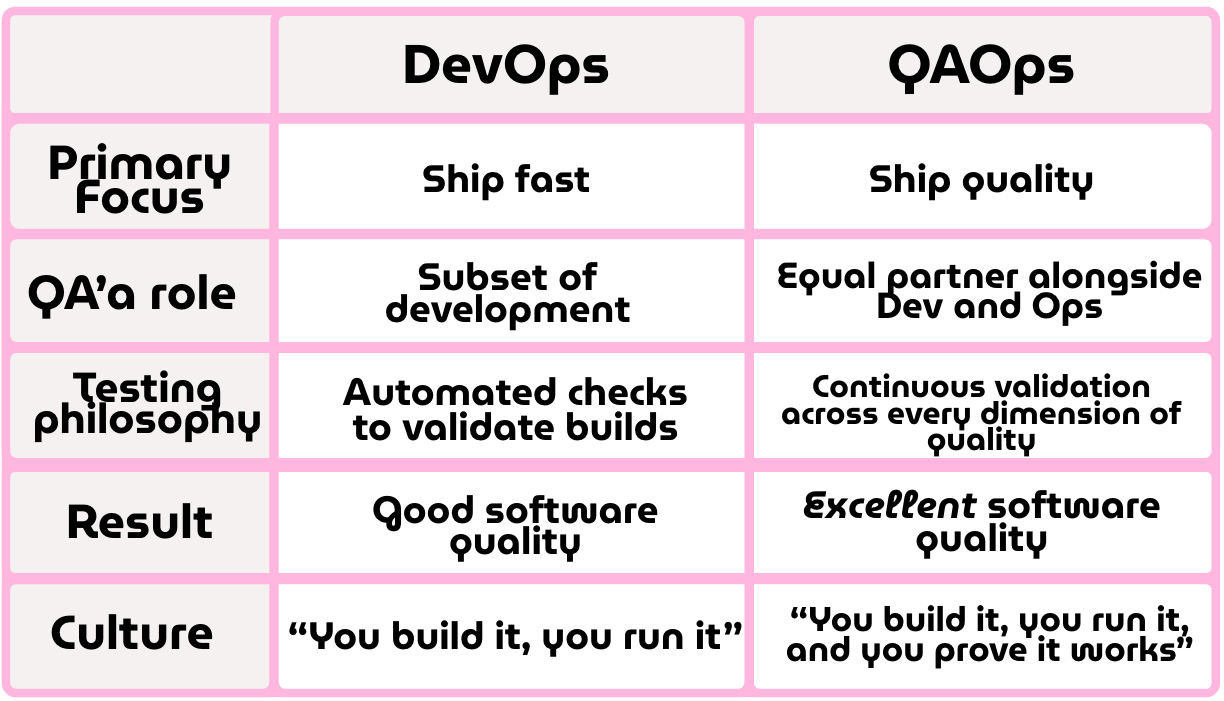
DevOps asks: "Can we deploy this quickly and reliably?" QAOps adds: "And does it actually work the way it should?" It's not anti-speed. It's pro-confidence.
What This Actually Looks Like
In QAOps, developers and QA testers work as one integrated team rather than separate silos. Here’s how it typically looks:
- Sprint/Planning Stage
- QA joins planning sessions early.
- Together they define acceptance criteria and testing strategies before coding begins.
- Development Phase (Shift-Left)
- Developer writes code + unit tests.
- QA may pair with the developer to review test coverage or suggest edge cases in real time.
- Automated tests (unit + integration) run automatically on every commit.
- Code Review & Testing
- Pull Request → Automated test suite runs.
- QA reviews the PR with a focus on testability, potential risks, and missing scenarios.
- Real-time collaboration: Developer and QA jump on a quick Slack/Zoom call to discuss or debug together instead of back-and-forth comments.
- Exploratory & Manual Testing
- QA performs deeper exploratory testing.
- Developer is available for immediate fixes if issues are found.
- Deployment & Monitoring (Shift-Right)
- After deployment, both monitor production metrics and user feedback.
- If issues appear, the developer + QA pair to resolve them quickly.
Example Flow for a New Feature (like adding real-time status indicators in an online software social media platform):
- Developer builds the feature + basic tests.
- Automated pipeline runs regression + integration tests.
- QA does exploratory testing on multiple devices/browsers.
- They discuss findings instantly and fix issues in the same day.
This collaborative style reduces handoff delays and creates faster, higher-quality releases.
Why QAOps Delivers More Value Than DevOps Alone
- Catch bugs when they're cheap to fix. When QA is in the pipeline from day one, a bug found in a pull request costs a fraction of one found in production. QAOps makes early detection structural, not aspirational.
- Eliminate the "QA bottleneck" myth. In traditional DevOps, QA is often the place where releases pile up. QAOps distributes testing throughout the pipeline so there's no queue -- just continuous, parallel validation.
- Better customer experience by design. Regression testing, exploratory testing, geolocation testing, and accessibility testing all run as part of the pipeline. Users don't just get features faster; they get features that work and work in a way that makes sense.
- QA engineers level up. When testers work directly with developers and ops engineers, they pick up scripting, infrastructure, and pipeline skills. They become more valuable -- and the organization becomes more resilient.
- Reporting that actually drives decisions. Systems like like GitHub Actions, GitLab, Jenkins, or Jira now automatically create analytics dashboards that displays software testing results continuously throughout the CI/CD pipeline. This shifts quality tracking from a post-deployment bottleneck to a continuous, transparent operational process.
The Agentic AI Reality: Shift Testing Everywhere
Here's where QAOps gets genuinely exciting – and where it leaves even mature DevOps setups in the dust. The rise of Agentic AI (think autonomous coding agents like GitHub Copilot, Cursor, Devin, and the dozens of AI coding assistants now embedded in every IDE) has fundamentally changed who – or what – is writing code. Most developers today aren't just writing code; they're reviewing and directing code that an AI agent wrote. And that creates a brand-new problem: how do you verify work that wasn't written by a human in the first place and do so at the speed that an agent can spit out?
With QAOps and Agentic AI combined, the AI agent:
- Generates and maintains tests that validate actual user behavior
- List all the various QA tests needed: smoke, end to end, regression, sanity, exploratory etc
- Catches regressions, accessibility issues, and browser-specific bugs
- Validate that an AI-coded fix actually works in QA/staging environment– not just that it compiles in the development environment
- Verifies the agent's own output for a bug fix or new feature (since dev agents can be confidently wrong) along with verifying the developer's confidence in his own code by actually running some of the QA tests (any that don't need a human to validate)
This is exactly where platforms like Playwright and Puppeteer become additional game-changers for QAOps (developers and QA testers alike) and where the philosophy of "quality from the start" stops being aspirational and starts being literal and in real time.
Playwright and Puppeteer: QA Testing While You're Still Writing Code
Playwright (Microsoft's open-source browser automation framework) and Puppeteer (Google's Node library for headless Chrome) were originally built for end-to-end testing and browser automation. They are used for shift left testing, testing while still in the developers hands and shift right testing, testing in production once the code has been deployed. But specifically in the QAOps world, they've added even more value as they provide automatic testing for the developer after he/she and his/her agent have written the code but before the code is submitted in a pull request to merge into the main code base. By the developer using these tools right after the code is generated and deployed to his development environment (before the code is given to a traditional QA tester) they act as a good first sanity check for what's been written or rewritten.
With QAOps, QA testers work with developers on their machine in their development environment or side by side them in some manner to validate together. can use those same tools to automatically test and give quick feedback to the developer. If something is wrong, doesn't make sense, or isn't intuitive to the end user, the developer can take that feedback and adjust (or have their agent adjust) the code, run a "build" on that code to test for syntax errors, and deploy to the developer's local environment for manually testing by the developer and QA person to do or for automatic testing by their agent. With both developers and QA testers doing this closely together, the feedback loop between QA and development is more productive and shorter so things can be adjusted quicker.
This is the QAOps promise made real: QA testing isn't a phase after development. It's a companion during development made even better by real teamwork and happening automatically when an agent is involved and prompted or guided to do so.
Why QAOps Matters More Now Than Ever: Checking the Agent's Confidence
Here's the quiet revolution happening in software teams right now: most developers are using AI agents not just to write new features or bug fixes for them (and then validating the output), but also connecting them to the platform where bug reports are recorded and prioritized (also by agentic AI), so that they can automatically reads the bug description details, analyze the part of the codebase that is related, then automatically suggest code changes, run a build to validate it, run Playwright and other tools to further validate, and one approved by the developer, build a pull request to merge the fix with the main code base. That's amazing for velocity for finding and solving bug in software, but it introduces a trust problem no one talks about enough.
Agentic AI is fast, but it's also confident, sometimes confidently wrong. An agent might fix the symptom of a bug without addressing the root cause or not fix it correctly all the way. It might close one regression while silently opening two others. It might generate code that passes unit tests but fails spectacularly under real browser or load conditions. The agent doesn't know it's wrong. It just knows it looks right when looking at the bug report and the code.
Early collaboration between developers and QA testers, along with tools like Playwright and Puppeteer are the antidote to that overconfidence. When your AI agent submits a fix and a Playwright test suite immediately runs a full E2E (end to end) pass against it, you get something invaluable: an independent verification that the agent's work actually does what it claims to do. Not "the agent said it fixed the bug." Not "the unit test passed." But the browser actually behaves correctly, the user can complete the flow of the task, and nothing else broke. The agent also saves tremendous time in the development phase by keeping the developer from having to read every line of code that the agent changed or added.
The benefits of this are passed to QA testing where a second set of human eyes and brain review the new feature or bug fix for further validation and deeper testing. While developers can use agentic AI tools to authenticate what their agent just spit out, they themselves are not QA testers. QA testing is a different mindset than, "build exactly this" or "fix this particular issue". QA testers know all the different types or forms of testing that are needed based on what code/feature was changed or added. Their job is to think with a wider viewpoint, more content, and know how that new feature or bug fix will affect the product code around it. With agentic AI tools, they can flow through these tests faster, using an agent to perform the tests that can be automated and performing the manually tests that still need to happen.
Here is the New Workflow Based on That
- Developer (or agent) writes or fixes code, runs a build to check for syntax errors and deploys it on the developer's local development environment.
- Playwright/Puppeteer tests fire locally in seconds, validating the change in a real browser environment.
- Developer reviews both the code and the test results – catching issues the agent may have introduced before they ever touch CI.
- Code ships to CI with confidence (where the CI also runs standard automated tests), because it's already been QA-validated at the earliest possible point. After it goes to the CI, it gets deployed to the test/staging environment before finally going to production.
- QA Tester also uses Playwright/Puppeteer while adding a new perspective of , "does this makes sense", "is this initiative for the user", "is this a good flow for the user or does this really solved the reported issue"?
The magic of this is that it serves two masters at once. The developer gets fast feedback on their own work as they write the code (more so than before with just CI testing). And the agent's work gets a second set of eyes – mechanical, thorough, unimpressed by confidence – that no human reviewer could match for speed or consistency. Then QA testers bring in their deeper perspective, wider range of tests, manual tests when needed, with their agent tools as well. It's shift left testing at its most literal: quality assurance baked so deeply into the process that it's happening before the process even gets to "QA" for final checks. And with the early collaboration with QA testers, what gets finalized and pushed in the software update happens quicker and better than ever before.
Companies Nailing QAOps
Netflix – The streaming giant is legendary for its DevOps culture, but its approach to quality is equally QAOps-flavored. Netflix's Chaos Engineering program (powered by their Simian Army tools like Chaos Monkey) intentionally introduces failures into production to validate system resilience. QA isn't an afterthought – it's baked into their infrastructure philosophy. They test in production, and they test constantly.
Spotify –The company behind the famous "Squads, Tribes, Chapters, and Guilds" model gives QA engineers a seat at every squad table. Their testing infrastructure runs thousands of automated tests on every build, and quality advocates (yes, that's an actual role) embed directly in cross-functional teams. The result? A platform serving 600M+ users that ships continuously with confidence.
Microsoft – Microsoft's transformation under Satya Nadella is a DevOps success story, but their QAOps game is equally strong. Microsoft runs millions of automated tests daily across their product lines. Azure DevOps pipelines incorporate testing gates at every stage – unit, integration, E2E, performance, and security. Their engineering system treats a failed test as a blocking event that no one can override without visibility. And yes, they created Playwright – the same tool that's now helping teams embed QA directly into the developer's workflow and empowering better QA testing for QA testers. That's not a coincidence. When your QA philosophy matches your tooling philosophy, you get QAOps.
Google – Google popularized the idea that testing is not a role – it's a discipline. Their "Engineering Productivity" teams own the testing infrastructure and tools, while every engineer writes tests. Google's Blunderbuss and Flaky Test management systems route tests intelligently and quarantine flaky ones, ensuring the CI/CD signal stays clean. Quality is literally infrastructure at Google ("or so they say" - Apple user).
The Bottom Line
DevOps cracked the code on speed and collaboration between dev and ops to ensure better and faster deployments, which also necessitated real standard code testing. QAOps enhances the process by ensuring that quality – real, measured, continuous, user-centric quality – isn't an afterthought or phase that happens further down the line. It's a living part of the process from A to Z so features, updates, and bug fixes can be better evaluated as a team as early as possible.
With as fast as things develop and change now, this is all the more important. Teams and companies can't afford to spend time on a feature, bug fix etc that isn't validated early on. More than ever, they need agentic AI tools and platforms that test and confirm as early as possible in the process, especially if and when developers are using agentic AI to write code. Additionally, developers and QA testers need to be on the same page about "what is going on" and not forced into a game of tennis where they hit the generated code back and forth over the net.
As the culture of what software can do and what people want/need ramps up even faster and faster, the ones that win won't just be the ones that deploy most frequently. They'll be the ones that deploy with the most confidence and that comes from everyone in the development cycle being on the same page from programmers to QA testers and beyond. QAOps is how you get there.
The evolution of software development went like this: Waterfall taught us planning, Agile taught us iteration, Scrum and Kanban taught us flow, and DevOps taught us speed for deployments (and did refine a lot of the testing naturally). QAOps teaches us the lesson that was there all along but we kept deferring: quality isn't a checkpoint in the development cycle– it's a "way of being" and one that should be a part of the development cycle from the beginning. It's not just that time is money, tokens spent is money spent as well. QaOps shifts QA testing to happen early in the development process and encourages more interconnectedness among teams, who together can evaluate and test features and bug fixes at a higher level. Now with Agentic AI, both teams can do so with greater efficiency and at greater speeds on both sides, the creation of code and the proving of code.
Want to go deeper? Check out BrowserStack's QAOps guide (https://www.browserstack.com/guide/what-is-qaops) for implementation details, and the Atlassian DevOps history overview (https://www.atlassian.com/devops/what-is-devops/history-of-devops) for more on the methodology evolution.