How Code Testing Has Changed Over the Years
Full Article:
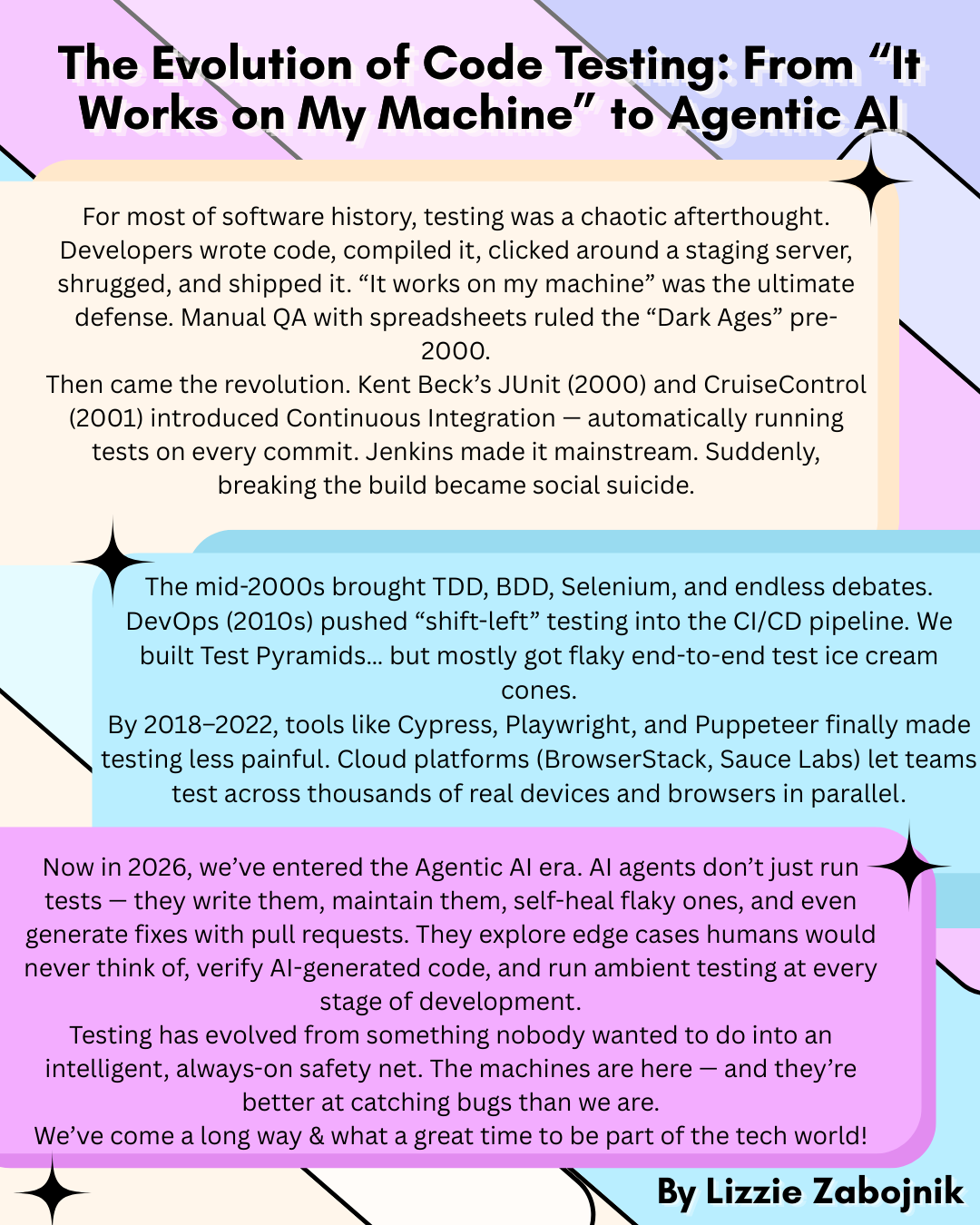
Let's be honest. For most of software history, "testing" meant one developer clicking around a staging server at 4:55 PM on a Friday, shrugging, and saying, "Looks good to me." Then they pushed to production, and Monday morning the phone rang off the hook. Although it's hard to believe these days, this was a reality when the internet was young and companies didn't have formal code testing processes or code development methodologies.
We've come a long way. What follows is the story of how code testing went from an afterthought that had to be manually implemented to an automatic phase in CI (Continuous Integration that auto run strict, standard tests to ensure new code works with the rest of the existing code before merging it in), to living breathing process that runs automatically in CI and is managed by AI agents that are arguably better at catching bugs than the developers who wrote them. Progress!
Phase 1: The Dark Ages -- "Testing" (Pre-2000)
Before CI, before automated test suites, before basically anything that would pass for professionalism today, testing was a vibe. You wrote code. You compiled it (translated it from something a human can read to something a machine can read, for those programming languages that aren't compiled already). If it didn't crash immediately, you shipped it to end customers. If it did crash, you often added a // TODO: fix this later comment and shipped it anyway.
There were testing frameworks, sure. JUnit showed up in 2000 and gave Java developers structured unit testing for the first time. But let's be real: most developers treated unit tests the way most people treat their gym membership -- they knew it existed, they felt vaguely guilty about not using it, and they'd definitely get around to it next week.
The dominant testing methodology was manual QA: a room full of people clicking through test cases on spreadsheets, trying to account for many scenarios as possible, hoping nothing exploded. It was slow, expensive, and about as reliable as a weather forecast. But hey, it was something.
The real innovation of this era? The phrase "it works on my machine" – the universal developer alibi that blamed the environment (like production versus development) instead of the code, every single time.
Phase 2: Continuous Integration Enters the Chat (2000--2006)
Enter Kent Beck, progenitor of Extreme Programming and the testing-obsessed madman who gave us JUnit in 2000. Beck believed tests should be written before code – a radical idea called Test-Driven Development (TDD) that most developers respected in theory and ignored in practice. Like having some sort of plan, direction, and way to measure your output before trying to shoot for the moon.
But TDD needed something to run those tests automatically and in a standard reliable way, every time code changed. That thing was Continuous Integration, and the tool that made it real was CruiseControl (2001). CruiseControl was a Java-based CI server that would check out your code from version control, build it, run the basic tests that were needed, and tell you if something was broken. Revolutionary concept at the time: breaking the build before it reaches production, not after.
Then came Hudson in 2005 (later forked into Jenkins in 2011 after Oracle's acquisition of Sun Microsystems threw a wrench in things). Jenkins became the CI server that everyone loved to hate – ugly UI, XML config files that looked like they were designed by a committee of crazy people, and enough plugins to fill a small app store (that's a lot). But it worked. It ran your tests on every commit, flagged failures, and sent those shaming emails to the whole team: "BUILD FAILED. The following 47 tests are now broken. Have a nice day."
CI changed the culture. Breaking the build became an embarrassing or tactless social mistake – the software equivalent of leaving your dirty dishes in the office sink. Developers started running tests locally before pushing to the main branch of code, because nobody wanted to be that person who turned the CI pipeline red at 5 PM.
The takeaway: CI didn't make developers write better tests. It made them feel guilty about not writing tests. That guilt, it turns out, was highly motivating.
Phase 3: TDD, BDD, and the Golden Age of Frameworks (2006--2012)
The mid-2000s were the era of developers deciding that if they were going to write tests, they were going to write a lot of tests, and they were going to have strong opinions about it.
Test-Driven Development (TDD) went mainstream. The cycle was simple: write a failing test, write the minimum code to make it pass, refactor. Red, green, refactor. Developers who practiced TDD became evangelists, cornering you at conferences to explain that you weren't a real engineer if you didn't write tests first. Developers who didn't practice TDD nodded politely and kept not doing it.
Behavior-Driven Development (BDD) emerged in 2006 when Dan North decided that TDD wasn't accessible enough and created the BDD framework JBehv (later RSpec in Ruby, Cucumber as a cross-language tool). BDD let you write tests in near-English: Given I am on the login page / When I enter valid credentials / Then I should see my dashboard. Product managers loved it. Developers, who just wanted to write code, pretended to love it. Everyone argued about whether it counted as "real" testing.
This era also gave us:
- Selenium (created in 2004, but exploded in popularity during this period) – browser automation tests, which was revolutionary in concept and excruciating in practice. Writing Selenium tests felt like teaching a very slow, very literal robot how to use a website. "Click this button. Wait. No, wait longer. Now check if this element exists. It doesn't? Wait again. Ah, there it is. OK, now proceed."
- Watir (2003) -- Ruby-based browser testing that was beloved by Rubyists and ignored by everyone else.
- Robot Framework (2008) -- keyword-driven testing that let non-programmers write tests in keyword tables. It was either empowering or patronizing, depending on who you asked.
The takeaway: This era proved that developers will absolutely adopt any testing methodology, as long as there's a lively debate about whether it's the right methodology.
Phase 4: The DevOps Era and "Shift-Left Test Everything" (2012--2018)
As DevOps culture took hold (the era of developers writing code and operations who deployed the code working together in true harmony), testing got dragged into the CI/CD pipeline whether it liked it or not. The philosophy of "shift-left testing" became the battle cry: catch bugs as early as possible in the development lifecycle, because the cost of fixing a bug in production is roughly a gazillion times more than fixing it during development.
Jenkins was now running the world's CI pipelines. Travis CI (2011) and CircleCI (2011) brought CI to the cloud, making it dead simple for open-source projects and startups to run tests on every pull request. GitLab CI (2015) baked CI/CD directly into the Git platform.
The testing stack evolved into a layered cake:
- Unit tests (JUnit, pytest, RSpec) -- fast, isolated, run on every commit
- Integration tests -- verify that services talk to each other correctly
- End-to-end tests (Selenium, still Selenium, always Selenium) – software testing methodology that simulates real user experiences to validate the complete workflow of an application from start to finish
The challenge? The Test Pyramid. Coined by Mike Cohn, the pyramid said you should have lots of fast unit tests at the bottom, fewer integration tests in the middle, and very few slow, brittle E2E (end to end)tests at the top. In practice, most teams ended up with an ice cream cone -- a few unit tests at the bottom, and a giant, slow, flaky mass of E2E tests at the top that broke for no reason and everyone hated.
This era also introduced code coverage tools (Istanbul, Cobertura, JaCoCo) that gave teams a metric to chase. The problem? A team with 80% code coverage could still ship a product where the login button didn't work, because the 80% of code they tested didn't include the part that mattered. Code coverage became the common beginner programming exercise of testing: a number that tells you something, but definitely not everything.
The takeaway: DevOps gave us the development pipeline. We filled it with flaky Selenium tests that failed intermittently and built dashboards to visualize our shame. But hey, at least the tests were running automatically and every time.
Phase 5: The Testing Renaissance -- Cypress, Headless Browsers, and Hey Maybe Testing Doesn't Have to Suck (2018--2022)
Something changed around 2018. Testing started to get, dare we say, good.
Cypress (2017, mainstream adoption 2018-2019) arrived and made Selenium look like a rotary phone or a mix tape. Cypress ran inside the browser, had automatic waiting (no more sleep(5000) hacks), time-travel debugging, and a developer experience that didn't make you want to throw your laptop out a window. For the first time, writing E2E (end to end) tests felt almost pleasant. Almost being the key word.
Puppeteer (2017) -- Google's Node library for controlling headless Chrome -- gave developers programmatic access to a real browser without the Selenium dance of downloading drivers and managing browser versions. Suddenly you could write browser automation that was fast, reliable, and didn't require a PhD in WebDriver configuration.
Playwright (2020) – Microsoft's entry into the browser automation space – took everything Puppeteer did right and made it cross-browser (Chromium, Firefox, and WebKit). It added auto-waiting, network interception, and mobile emulation out of the box. Playwright made it possible to write one test that runs across three browser engines and catches that one weird Safari bug that nobody could reproduce. Anyone who has done QA testing knows that this is a real thing.
This era also gave us:
- Testcontainers (2015, mainstream 2018+) -- Docker containers that spin up real databases and services for integration tests. No more mocking your database and hoping for the best.
- k6 (2017) -- load testing that developers actually enjoyed writing (which, for load testing, is saying something).
- GitHub Actions (2019) – CI/CD built into GitHub, making it trivially easy to run tests on every PR (pull request for new code) without managing a Jenkins server from 2008.
The testing narrative shifted from "should we test and how much do we have to?" to "how do we test faster, more reliably, and without our E2E suite taking four hours?" The answer, increasingly, was parallelization, selective test runs, and better tools.
The takeaway: After twenty years of developer time being wasted on Selenium's explicit waits and driver mismatches, the testing industry finally admitted that maybe the developer experience of writing tests should be, you know, not terrible.
Phase 6: Cloud Testing Platforms and Testing at Scale (2020--2024)
As applications grew to serve millions of users across hundreds of device and browser combinations, testing on your local machine became laughably insufficient. "It works on my machine" was never a great defense, but now it was an outright lie -- because "my machine" was a $3,000 MacBook Pro and your users were on a four-year-old Android phone running a browser nobody had heard of.
Cloud testing platforms stepped in:
- BrowserStack and Sauce Labs gave teams access to thousands of real browsers and real devices on demand for testing all kinds of end user environments. You could run your Playwright tests across 50 browser/device combinations in parallel and get results in minutes.
- Applitools brought Visual AI to testing -- using machine learning to detect meaningful visual changes (not just pixel-by-pixel diffs that flag every minor rendering difference). Your button moved 2 pixels? Applitools knew whether that was a real bug or just Chrome being Chrome.
- Datadog Synthetics and New Relic Synthetics added continuous testing from a monitoring angle -- simulating user journeys from locations around the world, 24/7, and alerting you before real users noticed something was broken.
Parallel testing became the norm. CI pipelines now spun up 20-50 test runners simultaneously, running suites in minutes that used to take hours. Test impact analysis tools (like Launchable) used ML to predict which tests were relevant to a given code change, so you didn't have to run 5,000 tests when only 50 of them actually touched the code that changed.
This era also saw infrastructure-as-code testing mature. Terratest (2018) and Checkov (2019) let teams test their Terraform configurations before deploying them, because the only thing worse than a buggy application is a buggy infrastructure that you can't easily roll back.
The takeaway: We finally admitted that testing on one browser on one developer's laptop was not, in fact, a comprehensive quality strategy. The cloud made it possible to test everywhere, all at once. This was progress.
Phase 7: Agentic AI Testing -- The Machines Are Here and They're Better at This Than You (2024--2026)
And now we arrive at the current era, where the story takes a turn that would have sounded like science fiction even five years ago.
Agentic AI has entered the testing landscape, and it's not here to help you write tests. It's here to write them for you, run them, maintain them, fix them when they break, and catch bugs you didn't even think to test for.
Here's what testing looks like in 2026:
AI-generated test suites. Tools like Playwright's codegen and Testim now watch you interact with your application and generate complete, maintainable test suites in real time. You click through your app; the AI records the interactions, understands the intent, and produces tests that actually make sense -- not brittle recordings that break when a button color changes.
Self-healing tests. The flaky test, the bane of every CI pipeline's existence, is being solved by AI agents that can detect when a test failure is caused by a legitimate UI change (like a button being moved in a redesign) vs. an actual regression. If the selector changed because the component was refactored, the AI updates the test automatically. No more 9 AM "fix the flaky tests" standups.
Agent-written bug fixes. When an AI agent detects a bug in production or CI, it doesn't just file a ticket and wait. It generates a fix, opens a pull request, runs the test suite against the fix, and surfaces the verified solution to a developer for review. Amazon CodeGuru and GitHub Copilot Autofix are doing this now for security vulnerabilities. Snyk is doing it for dependency issues. The loop from "bug detected" to "bug fixed" is compressing from days to minutes.
Testing the AI agent's work. Here's the twist that makes this era genuinely different: most developers are now using agentic AI to write code (Copilot, Cursor, Devin, and similar tools). Those agents are fast and impressive, but they're also confidently wrong with unsettling regularity. An agent will "fix" a bug by addressing the symptom while missing the root cause, or introduce a new regression while closing the original issue. The testing layer -- particularly Playwright and Puppeteer running E2E validation in real browsers -- has become the independent verification system for AI-generated code. The AI writes it; the AI tests it; and another AI test suite verifies that the first AI's fix actually works. It's bugs all the way down, but now they're caught faster.
Exploratory testing by AI. AI agents don't just run scripted tests -- they explore. They click through flows that no human would think to test. They try edge cases like "what happens if a user enters their email in the phone number field?" or "what happens if the network drops mid-transaction?" They fuzz APIs, they test odd browser interactions, they generate traffic patterns that humans would never construct. Tools like Mabl and Testim are already doing autonomous exploratory testing, discovering bugs in user flows that nobody scripted a test for because nobody imagined that particular sequence of events.
Shift-everything. The shift-left movement moved testing earlier in the development process. Agentic AI is moving testing everywhere – before you write the code (AI suggests tests based on requirements), while you write the code (AI runs tests in your IDE in real time), after the code is written (AI validates the agent's work), and in production (AI monitors for regressions and auto-creates reproduction cases). There is no strict "testing phase" anymore. Testing is a continuous, ambient activity that happens at every stage simultaneously. And with how fast the market moves and how great the push is to automate software development thanks to AI, incorperating automated testing as early as possible has become even more valuable.
The takeaway: We've gone from "test if you feel like it or have to" to "tests are written, run, maintained, and fixed by machines that never sleep and never get bored." The dream wasn't that testing would disappear. The dream was that testing would become so automated and intelligent that you'd never have to think about it again. Code testing are the safety rails on the aisle to make sure that every code addition and change runs right down the middle and hits the target. We're not quite there in terms of perfection, but we're closer than anyone predicted even three years ago.
The Arc of Testing: A Very Brief Summary
| Era | Philosophy | Tools | Developer Sentiment |
|---|---|---|---|
| Pre-2000 | "Test it? I compiled it." | Manual QA | "If it compiles, it works." |
| 2000--2006 | CI: Break the build before it breaks prod | JUnit, CruiseControl, early Selenium | "Fine, I'll write a test." |
| 2006--2012 | TDD/BDD: Tests define behavior | RSpec, Cucumber, Selenium (still) | "I have strong opinions about how to write tests." |
| 2012--2018 | Shift-left: Catch bugs early, build the pyramid | Jenkins, Travis CI, Selenium (sigh) | "Our test suite takes 4 hours and half of them are flaky." |
| 2018--2022 | Testing doesn't have to hurt | Cypress, Playwright, Puppeteer, GitHub Actions | "Wait, writing tests can be... pleasant?" |
| 2020--2024 | Test everywhere, at scale, in the cloud | BrowserStack, Applitools, k6, Testcontainers | "We test on 3,000 devices and still miss Safari bugs." |
| 2024--2026 | Agentic AI: The machines are testing | Playwright + AI, Testim, Mabl, CodeGuru, Copilot Autofix | "The AI caught a bug I didn't even know existed, and I'm not even mad." |
The Moral of the Story
Testing went from something nobody did, to something everyone argued about how to do, to something machines do better than we do. The arc of testing history is the arc of software itself: manual, tedious, and error-prone at the start; automated, opinionated, and heavily debated in the middle; and increasingly intelligent, ambient, and invisible at the end.
The next time a test fails in CI and an AI agent fixes it automatically before you've finished your morning coffee, take a moment to appreciate how far we've come from the days of "it works on my machine." Or if you are like me, watch the magic behind the scenes as your agent plans, executes, and auto adjusts as needed while performing QA tests that used to take hours for a human to do. The speed, precision, and capability is simply amazing! Then fix your CSS. The AI can't do everything - yet.
Want to keep going down the rabbit hole? Check out Martin Fowler's original CI article from 2006, Playwright's documentation for the current state of browser testing, and DORA's State of DevOps Report for data on how testing practices correlate with software delivery performance.