Why Agentic AI Isn't Optional Anymore, Especially in the Workplace
While AI is seemingly all around us, in our smart TV's, apps, platforms, even bird feeders, that doesn't mean that everyone is using it. Even if they are using it, it doesn't mean they are using near it's fullest extent. Most are still using is as a "super Google search engine". Most don't change to use a new tool unless they are pressed to do so and the pressure to produce more, go faster, and support more at work has increased and so has the pressure to use AI.
This certainly wasn't an overnight shift. Those who enjoy using and learning to use new tools were onboard first to use AI and then agentic AI, (AI that can accomplish tasks for you). Others that like to learn but need more of reason to jumped on the AI train after them. Then those who didn't jump until they had to started to get on board.
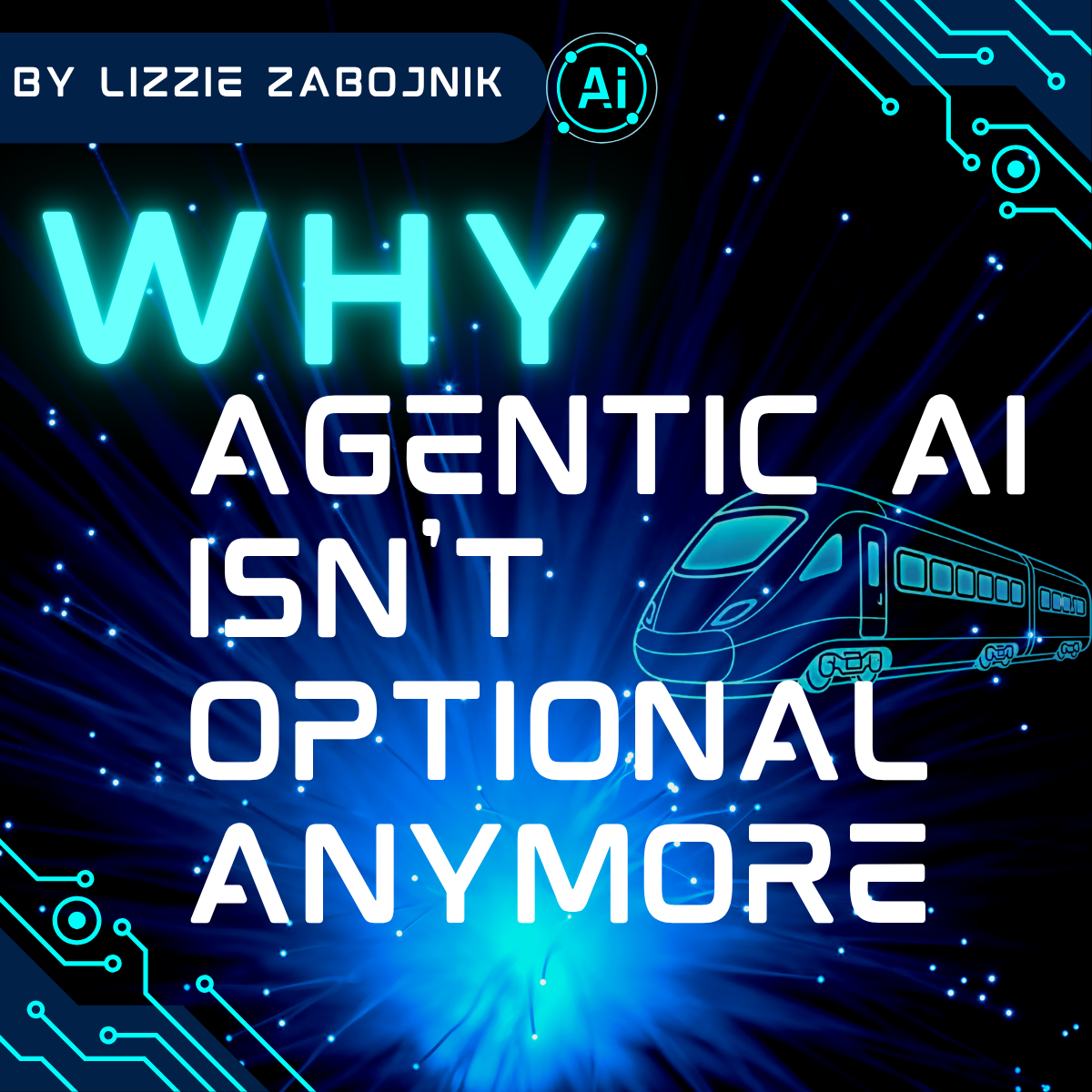
The reality now is that the people who are using agents to work along side them are producing more then those who are not. So matter what "boarding party" you are in, every company is trying trying harder than ever before to stay relevant and requiring more from their employees. The AI train is now racing down the tracks and those still on the platform waiting, looking at it suspiciously as it slows down for a stop to let them on, and simply dragging their feet to get on board, are getting left behind.
Even if using AI is not a requirement or you don't feel pressure from above to use it, when enough of your coworkers are using it and producing more, the platform you're standing goes from being a safe place to be where you are getting left behind.
This is the situation in companies all over the world, to people who didn't realize how big this would become and aren't sure what to do about it to the ones who did see it coming and have been anxiously awaiting the day to do all the things they have been planning to try with it. Overall, everyone is so mixed about AI. Some are excited. Some are overwhelmed. Some are still in denial about it's capabilities and effectiveness. But the dynamic is the same everywhere: when the people around you start using agents to multiply their output, the baseline for what's expected shifts — even if it shift subconciously.
The Train
Think of agentic AI adoption in a workplace like a train leaving the station.
When AI first arrive, only OpenAI (and others who were also secretly building it) were onboard. They came onto the scene and pulled a brand new powerful machine onto the tracks, inviting others to get onboard. A few curious people wander on — the ones who like trying new things, the ones who read tech articles on their lunch break, the ones who think "I wonder what this can do" and push to find out. And as more and more people hopped aboard, the train started moving faster and faster around the world. At first AI was a "super Google search engine". You asked it questions, it searched through its entire memory of the internet (up to a certain date) and it gave you a more well researched and wholistic answer based on all it read. This replaced the effort a person took to click and read/skim through articles and pages of results on Google to get the answer that they needed. With a simple "prompt", AI would return an answer that was based on all the revelant articles and webpages. During this time, a person using AI versus another not using AI was hardly noticeable. Their output at work was pretty much the same.
However, as AI grew in its capabilities, people could use it to do more. Then in Fall 2025, agentic AI came onto the scene and changed everything again. You could give AI access to different platforms that you use for projects or work and have it complete tasks for you in those platforma. In the development world, this became revolutionary! Most people started connecting their agent to Jira, Figma, Monday.com, Lucid, event scheduling software, HVAC scheduling software, and many other SaaS company platforms. At the same time, developer started using agents to evaluate software bugs or implement new features by reading their code based, suggesting edits to fix the bugs, implementing those changes, testing them and once passed, committing them, pushing them to GitHub (or wherever the companies codebase is stored) and submitting a pull request (PR) for review and then merging into the main codebase.
The people who started experimenting using their agent to connect with various platforms and/or assist with identifying, addressing, and testing software bugs or implementing new features are the ones who first boarded the AI train. They've been figuring out how to connect their agent to their CRM, how to pull data from their customer service ticket system, how to run a automated tests on the code and automatically record the results on the proper development tracking software. And suddenly — or what feels like suddenly, but is really the accumulation of weeks of quiet practice — their output starts to climb. They're closing more tickets. They're testing more features. They're writing more detailed updates. They're producing reports that used to take a full day in under an hour.
And you're still on the platform, doing things manually as you always have, watching the train pull away.
Here's the thing about this particular train: it doesn't slow down. It accelerates. Because the people on it aren't just using AI — they're getting better at using AI and thus they are able to do even more with it. Every day, they learn and test a new connector, a new prompting technique, a new way to orchestrate their agent across one more platform. Every day, the gap between the people on the train and the people on the platform gets a little wider. Not because the people on the platform are getting worse at their jobs. They're doing exactly what they've always done, at exactly the pace they've always done it.
At some point, the gap becomes visible. To more and more people. Your company notices that the dev team is shipping features faster. Your coworkers notice that the QA test updates are more thorough than they used to be. Your team notices that the reports they receive from different departments are more detailed, more data-driven, more frequent. Your team notices that certain members are able to keep up with more tasks. Nobody says "the people using AI are outperforming the people who aren't." They just notice that some people are producing more, and some people aren't.
That's when staying on the platform starts becoming a risky choice you are taking.
What Changes When Everyone Else Speeds Up
Everything changes when someone starts using an agent at work. What they do, how they do it, and the amount that they can produce all changes. And once employees and teams start using an agent and outputting more, they quickly get used to it and then that becomes the "new normal", the new standard, the new expectation. And if you're not using an agent, you're not just slower — you're operating in a different, lower-resolution version of the same workplace.
The Updates Get More Technical & Happen Faster
When a developer starts using an agent they go from "taking hours to fixed the login bug and then testing tomorrow" to a getting a thorough understanding of the bug, identifying the specific function that was failing, finding the API endpoint involved, implementing the code changes to fix it, deploying it to a developer's environment and performing tests, committing and submitting a pull request in under an hour. Not because the developer suddenly became a better at remembering how the entire codebase works or become faster at writing code. It's because their agent is pulling the context from GitHub and able to read it all in minutes. It can quickly cross-referencing it with the Monday or Jira pulses from past sprints. It can accurately compose an update based on the code changes that were implemented that includes everything a QA tester or a product manager might need to know.
The QA Testing Increases in Accuracy & Workload
If you're the QA tester receiving that update, your job has change as well. The developer has handed you a richer, more detailed handoff than they ever did before. But it also means the expectation has shifted. If the developer is writing updates with that level of detail, the QA tester response is expected to match. "Tested it, looks good" doesn't cut it anymore. The QA tester needs to respond with more technical and detailed testing and updates.
The more context from the developer's agent means better understanding for the QA tester as to what the developer changed and better test cases resulting in more thorough testing. A feature that used to require five test cases now requires fifteen, because the developer's agent or QA tester's agent helped them think through edge cases they wouldn't have considered on their own (or even with the library of tests from Playwright), and each of those edge cases needs to be tested.
The Number of Pulses a Development Team Can Work Through Increases — Maybe Even Triples
If the QA tester isn't using an agent to help perform automated tests and send a detailed auto update to Monday or Jira etc, not only will they not be able to output the same level of quality as the developer's agent, they will struggle with keeping up with the new level of output from the developers. Because as developers ship faster, the QA pipeline gets loaded with more items.
A development team that adopts agentic AI can potentially triple their throughput. The agent helps them write code faster, test their own logic before handing it to QA, draft pull request descriptions, update Monday pulses automatically, and cross-reference requirements against implementation. What used to take a developer hours or two days now takes them a couple of hours or less. What used to be a sprint's worth of work is now done by Wednesday or sooner.
This means the number of items arriving in the QA queue triples. Which means the number of items needing test reports triples. The means the number of updates flowing back to Monday.com triples. The number of customer notifications about resolved tickets triples. Which means the number of reports evaluating all of this activity — the patterns, the trends, the velocity — increases, resulting in everyone down the line having to keep up as well.
Every layer of the company feels the acceleration. And every layer needs to adopt agents just to process the volume.
The Updates to Customers Get More Wordy
When support agents start using AI to draft customer responses, the responses get longer, more detailed, more technically precise, and more empathetic — all at once. The agent pulls the ticket history, cross-references it with the known issue database, checks whether a fix has been deployed, and composes a response that covers every angle. It can also easily integrate with the company's Knowledge Base, read all the articles in a minute and know how to respond to the customer's question and even link the correct articles in the response. The customer gets a better answer, maybe a longer answer, and can even get that answer automatically responded to them during and outside of office hours based on how the compnay sets up the agent to respond.
If you're in support and you're not using an agent, you're now competing with responses that are more thorough than anything you could write by hand in the same amount of time. Not because you're not good at your job. Because the person next to you has a tool that pulls context from five systems and composes a response in thirty seconds, while you're clicking around to find the right article, remind yourself how that particular feature functions, and maybe even retesting that feature to remember how it works so you can respond accurately.
The Number & Type of Reports Needed Increase
When your company starts producing three times as much work, the need to understand that new workload as it's happening. Leadership wants to see velocity trends. Product wants to see feature request patterns. QA wants to see defect clustering. Support wants to see ticket volume by integration. The quarterly deliverables are now too bloated, and need to happen more often to zoom into what it really happening. Weekly and sometimes daily are now needed, because the data is moving too fast to wait for a quarterly review.
If you're the person who builds those reports or the person who should be building them and you're doing it manually, comparing data and recording what you see, can't possibly keep up at this point. The people using agents are pulling data from PostgreSQL, MongoDB, and Monday.com, HubSpot etc cross-referencing it, generating charts, and delivering a polished report before you've finished exporting your first CSV. Agents are making polish and professional looking PDF's with charts and graphs or all kinds, looking at data from every angle in minutes!
Once They Work Faster, Eventually You Need to as Well
This is the core dynamic. It's not ambition or showing off. It's about the basic math of a workplace. If your coworker is producing three times the output they produced six months ago, and you're producing the same output you produced six months ago, the gap between you isn't staying constant. It's widening. Every day, every week, every sprint, the gap grows. And at some point, the gap becomes the difference between "valuable team member" and "person that just doesn't do as much and feels overwhelmed."
You don't need to be the best agent user on your team. You don't need to build the most elaborate dashboards or orchestrate the most complex multi-platform flows. You just need to be on the train moving or trying to move at the same speed as everyone else. You need to use the best tools available and produce as much as you can with them. You need to be using an agent to enough of a degree that your output is keeping pace with the new baseline or at least not to far behind.
The Pressure to Adapt
When others come up with creative ways to use AI — building a dashboard that tracks integration ROI, creating an automated follow-up system that aggregates tasks from four platforms, generating a competitor analysis report that updates itself on a regular basis, the pressure increases for everyone else to do the same. Not because your manager is standing over your shoulder saying "you need to use AI." But because the evidence is everywhere. The person who built the integration ROI dashboard is now in every planning meeting, presenting data that nobody else has. The person who automated their follow-ups is responding to customers in half the time. The person who built the competitor analysis is shaping product strategy with insights that used to take a full analyst team to produce.
Eventually, people using AI can't be ignored. What they produce, how much they produce, and how often they do so is so visible and tangible that you need help keeping up with it all. You need your own assistant, you need to get onboard with using an agent. AI is a tool and just like with any other, it transforms the workplace and those using it will benefit from it and the company as a whole till too. It takes time to learn, but once others start using the better tool and doing more, soon it will become more stressful for you to not use the tool than it is to start learning to use it.
Hopefully, that pressure to use the new tool builds curiosity and you feel inspired to try to see what you can do with an agent. Hopefully, you ask "hey can I get access to an agent" and start small and work towards doing more. You may feel like the learning curve is high, but the crazy part if that you can ask your agent to teach you to use it. More on that later.
Having an Agent is Truly Helpful
Personally I love thinking about new ways to see, understand, and look at data. I love finding patterns that reveal where we can improve. I love creating new processes, new evaluation methods, new dashboards that take data from five systems and turn it into one clear picture. I love strategizing. I love forming a better plan based on what the data tells me. That's not work for me. That's play. It's the thing I do for free outside of work, but would also love to do it as my full time job.
So when agentic AI came along and my company put their AI policy in place and allowing us to use it at work, I was super excited. It gave me a tool that could pull data from Monday.com and HubSpot and build a live dashboard that shows me integration trends as well as a customize view that lets me know who I need to follow up with and when. When my CEO asked me to confirm how many customers bought integration X versus Y, I was able to build a live dashboard that showed who and when bought which one, who they were, and other details. The data that my agent used was easy to reference because it had links to all the emails and tickets regarding the customer's and third party vendors purchases. What would have felt like an overwhelming tasks my me searching through my inbox and HubSpot account, was done in a way that felt a fun investigation with a partner, my agent.
But not everyone is like that. I know that. Some people see agentic AI — or AI in general — and feel uncertain or intimidated. They hear "connect your agent to five platforms and you can orchestrate a multi-step flow" and their brain doesn't light up with excitement. It shuts down. It feels like too much technology, too fast and it's just too different from the way they've worked for ten or twenty years. But here's what I can tell you: it really is easier than you think. And the cost of not getting on the train is higher than the cost of stumbling through the first few weeks of learning to use it.
You Can Start Small
Here's the thing that nobody tells you about working with AI: most of it is trial and error. You don't need a course. You don't need a certification. You don't need to read a book about prompt engineering. You need to open an agent and ask it what it can do.
Ask it: "Can you read this spreadsheet, create this formula, summarize this for me?" It'll say yes — or it'll say no, and tell you why. Maybe it doesn't have the right permission. Maybe it needs the file in a different format. Maybe it needs access to your Google Drive. And here's the part that surprises people: it will usually help you help it. It'll say: "I can't read that spreadsheet because I don't have access to your Google Drive. If you download it as a CSV and upload it here, I can read it." Or: "I don't have a connector for that platform, but if you give me the API key, I can try to pull the data directly." The agent tells you what it needs, and once you give it what it needs, it does the thing.
You don't need to know everything the agent can do before you start. You learn it by doing. You try something. It works. You try something harder. It doesn't work. You ask why. It tells you. You adjust. It works. That's the entire learning loop. And each time through the loop, you're a little more capable, a little more comfortable, a little more on the train.
No one should be scared by it. I know that's easy for me to say because I'm the person who finds this fun. However, I've watched people who were genuinely intimidated by AI go from "I don't know how to use this" to "I just built a dashboard that summarizes everything that I need to do next week from my email, CRM, Zoom recording etc" in a matter of weeks. Not because they became technical. Because they kept asking the agent what it could do, and the agent kept showing them.
It's Not Just for Terminals and Chatbots
One of the reasons people feel overwhelmed is that they think "using AI" means one specific thing. They think it means opening a terminal, if they know what a terminal is, and typing commands. Or they think it means going to ChatGPT or Grok and typing into a chat box, which doesn't do much more than them Googling something. And if that's the only interface you know about, agentic AI feels either feels too technical or too narrow.
But it's not. There are all kinds of modules and platforms that use AI, and they're built for people who don't know what a terminal is and don't need to. Plus they do way more than what a supercharged search engine does.
Lovable. You can use Lovable to build entire interactive websites by describing what you want. You don't write code. You don't drag and drop. You tell the AI what the site should do, and it builds it. You learn as you go — each iteration teaches you something about how to describe what you want more clearly, and the AI gets better at delivering it. You can build a tracking page, a dashboard, a form, a whole application — and you're learning AI orchestration the entire time without ever opening a terminal.
Canva. The image creator in Canva is AI. You describe what you want an image to look like, and it generates it. That's agentic AI in a creative context — and it's accessible to anyone who can use a web browser. You're not "using AI" in the way a developer uses AI. You're using it in the way a person uses AI. And that counts. That's on the train.
Lucid. You can ask the AI in Lucid to make you a diagram of something — a process flow, a system architecture, a decision tree. Something that's simple to visualize but tedious to create when you have to drag and drop every box, draw every arrow, and think of every step. The AI does the thinking and the placing. You review and refine. You're orchestrating an AI to produce a visual output, and you're learning how to guide it — which is the same skill, at a smaller scale, that you'd use to guide an agent through a multi-platform data pull.
The point is, you can use it in tools you already know or tools that make it super user friendly to use AI. This means that you can use AI in ways that feel comfortable, and build your comfort level from there. The train has different cars. You don't have to board in the engine room. You can board in the passenger car and walk forward when you're ready.
Agent Work Isn't Always Easy, but Worth It
Working with AI is, for me, truly a joy. Most of the time. But in reality, sometimes you fight with it. For me, sometimes I prompt it to find all the tickets on topic X and it misses some. Sometimes the test that I have it perform require me to prompt it to do over and over to really nail what's happening and I burn through more tokens than I realize. Sometimes the reports it produces are too "fluffy" and need to be more fact focused, so I need to correct it.
So take the approach that you are "going to learn how to do this and do it better each time," then every fight, every misfire, every extra token spent is not waste. Just like you are learning to use an agent, the agent is learning you, what you want, how to gather what you want, how to test the way that you want it to, and how to write reports the way you want it to.
The small wins matter. The first time the agent successfully reads a spreadsheet, the first time it writes back to Monday, the first time it runs a test and captures the results are real wins.
We All Know the Sad Truth & Hope
There isn't a way to avoid the fact that AI will replace some jobs. Every major advancement in technology does. The printing press replaced scribes. The automobile replaced stable hands. The spreadsheet replaced rooms full of accountants with adding machines. The internet replaced travel agents, encyclopedia salespeople, and a hundred other professions that used to exist because they sat between information and the people who needed it.
AI will do the same thing. Some roles will shrink. Some will disappear. Some will transform so completely that the person doing the job today wouldn't recognize the job description in three years. AI is even making it more difficult for people to get jobs or switch careers.
But here's the thing that every technological shift has also proven & hopefully this will also play out with AI: the people who learn to use the new tool have a better fighting chance at staying in the workforce than the people who don't. The scribes who learned the printing press became typesetters and publishers. The accountants who learned spreadsheets became financial analysts. The people who learned the internet became the people who built the digital economy.
The people who refused to learn? They didn't disappear because they were bad at their jobs. They disappeared because the world moved and they stood still.
AI is the same. If you learn to use it — even at a basic level, even in a tool like Canva or Lucid, even if you never touch a terminal — you're moving. You're on the train. You're adapting to the new baseline. And the person who adapts, even imperfectly, is more valuable than the person who doesn't adapt at all.
The people who will thrive in the next five years aren't the people who know the most about AI. They're the people who are willing to keep learning about AI. The willingness is the skill. The tool changes. The models get better. The platforms multiply. But the person who approaches each new iteration with "let me try that" — that person stays on the train, no matter how fast it goes.
Bottom Line
The train is already moving. It left the station a while ago, and the people who boarded first are producing more volume and value and that is starting to affect those around them. The more that is produce and the greater value of what is produce is getting hard to ignore. As a result, the pressure for others to start using an agent at work is increasing. In order for them to keep up with the speed and velocity that others are moving act, it's time for most people to start using an agent.
But it's not too late and the train has room for everyone. The boarding pass isn't a computer science degree or a terminal command or a tech certification. It's a question. "Hey agent, what can you do?" That's it. You ask the agent what it can do, and it shows you. You ask it to do something, and if it can't, it tells you why — and it helps you figure out how to get there. You try. It works. You try something harder. It doesn't work. You learn why. You try again. It works. And you're on the train. Start small and keep going!
For people like me, who people who love finding patterns, building dashboards, creating new ways to see data, and orchestrating agents across platforms, this is the most exciting time to be alive in the workforce. But you don't have to love data or patterns or dashboards. You just have to be willing to try. Step on the train, ask what it can do, and see where it takes you.
Once your coworkers start doubling their output with agents, keeping up isn't about ambition — it's about survival. However, any workplace that allows their employees to use an agent is giving them the same opportunity to start using the tool that helps employees produce more. You just have to get over the learning hump and make the effort to actually start using it.