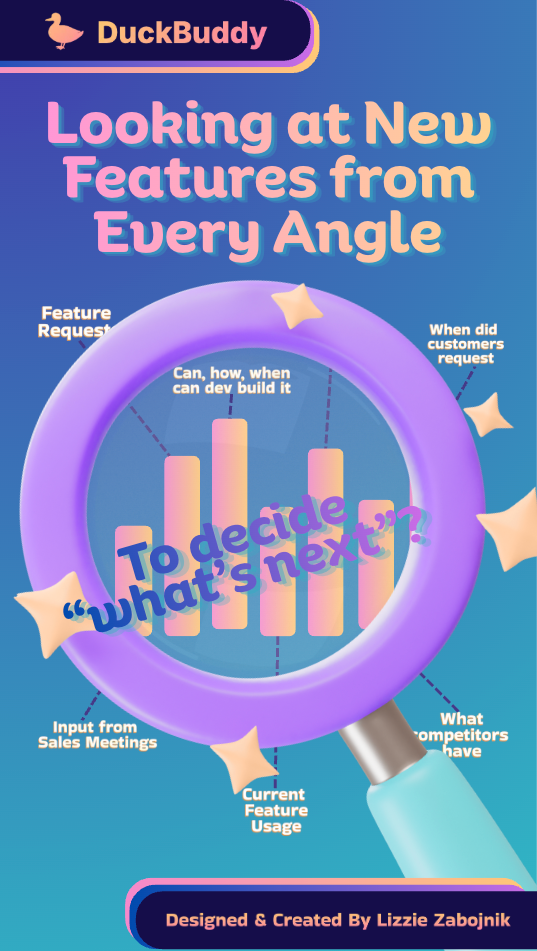
Looking at New Features from Every Angle: Why the Right One Matters More Than More Features
Every product company faces the same temptation: the backlog never empties. Customers ask for more. Competitors ship something shiny, again. Internal teams generate ideas. The result is a long list of potential features, each of which could theoretically improve the product. Yet adding features is not the same as building the right features. The ones that make current customers enjoy the product more, attract new ones, and remain reasonable for development and support to build and maintain are the ones that actually move the business forward. Everything else is noise that dilutes focus, burns engineering capacity, and risks delivering something “too late” or simply off the mark.
The key is to stop treating any single source of input as decisive and instead examine the desire for a new feature from multiple angles at once. Only then does a clearer picture emerge of what the feature actually needs to be, whether it should be built, and when it belongs on the roadmap.
Different Lenses, Different Signals
Customers often treat feature requests as the primary deciding factor. They experience the product daily and know where friction lives. Sales teams, however, hear a different conversation. In discovery calls and competitive deals they learn what prospects say is missing and what is causing them to choose a rival. Support teams sit closest to day-to-day pain: the tickets that keep coming in reveal what is broken, confusing, or incomplete for existing users. Development evaluates feasibility—what is realistic to build, how long it will take, and how hard it will be to maintain. Each of these viewpoints is valid. None of them is complete on its own.
When these signals are collected in isolation, teams risk building the wrong thing. A flood of customer requests may reflect the loudest voices rather than the highest-value needs. Sales pressure can push the product toward feature parity with competitors even when those features deliver limited retention value. Support tickets can over-index on edge cases. Engineering preference for “easy” work can leave strategically important but complex capabilities unfinished. The only reliable approach is to treat every data point as input that must be weighed together, prioritized, and then handed to the product manager, who decides placement on the roadmap.
A Practical Checklist for Evaluating a Potential Feature
Before any feature advances, examine it through the following lenses:
- Customer feature requests: What volume and intensity of requests arrive from the current base? Are the same themes recurring across segments?
- Sales conversations: What do prospects and customers mention in meetings? Which missing capabilities repeatedly surface as objections or competitive differentiators?
- Support tickets: What pain points appear most frequently on the ticket desk? Which issues consume the most support time or generate the most frustration?
- Actual product usage: What do existing customers already use heavily? Which features correlate with retention, expansion, or high engagement?
- Subscription-tier behavior: Which tiers adopt the more complex capabilities today? Are higher-paying or higher-engagement customers the ones most likely to use the next advanced feature?
- Business impact: How much revenue and lifetime value does the company already capture from the users who would benefit most? Will delivering this capability protect or expand that revenue and keep the business on a successful trajectory?
- Development reality: What can engineering reasonably create? How long will it take, what dependencies exist, and what ongoing maintenance burden will it create? Has recent technology (for example, agentic AI) materially changed the effort or risk?
- Market attractiveness: From a sales and positioning perspective, what will be eye-catching? What will make the product more desirable to new customers and strengthen the company’s competitive story?
No single answer on this list should dominate. The goal is a composite view that balances desirability, viability, and feasibility.
Why Trends Over Time Matter as Much as Snapshots
Data points are not static. A surge of requests two years ago may have quieted because users found workarounds, switched products, or the underlying need evolved. Sales may once have closed deals comfortably and now face consistent losses to a competitor that shipped a comparable capability. Engineering may previously have judged a feature too complex, only to find that new tooling has cut the estimated effort in half. Usage patterns shift as customers mature or as pricing and packaging change.
Therefore every signal must be tracked longitudinally. Looking only at the current month’s request volume or the latest support themes can produce a distorted picture. Companies that maintain time-series views of request volume, sales objections, ticket themes, usage metrics, competitive losses, and engineering estimates are far better positioned to notice when a once-secondary idea has become urgent—or when a previously urgent idea has lost relevance. Weighting and prioritization then become living processes rather than one-time exercises. This discipline reduces the chance of building something that arrives after the market has moved on.
Chance Remains, But the Odds Improve
Product development has always contained an element of chance and judgment. No amount of data eliminates uncertainty about how customers will respond once a feature ships. Teams and companies that systematically gather the relevant data points, weigh them against one another, prioritize deliberately, and track them over time still gain a measurable advantage. They are more likely to select the features that delight existing users, attract new ones, remain supportable, and contribute to sustained business success.
In short, the backlog will always be longer than the capacity to ship. The discipline is not to ship more; it is to ship the right ones—by defining the right data points to track, weighing and prioritizing them, and tracking them over time. Examined them from every meaningful angle to get a holistic view and decide what to do next.