Learning Has Never Been Easier with AI

If you work at a company that builds software , you're a customer of one, or you're curious about how technology works, you've probably wondered what actually happens to a feature request after you submit it. It goes into the backlog... and then what? Why did that "small change" take four months? How many layers of technology had to be touched? Was the hard part the buttons? The database? Something in between?
You might know bits of the company's tech stack — the frontend, the backend, the database, the cloud storage. But there's no tool anywhere that takes "here's our tech stack, and here's my feature request" and explains what layers would need to be touched and how. No platform offers a "what would this request actually involve?" feature. It's a learning gap — and it's exactly the kind of gap that used to require finding a patient developer and buying them coffee.
The Solution
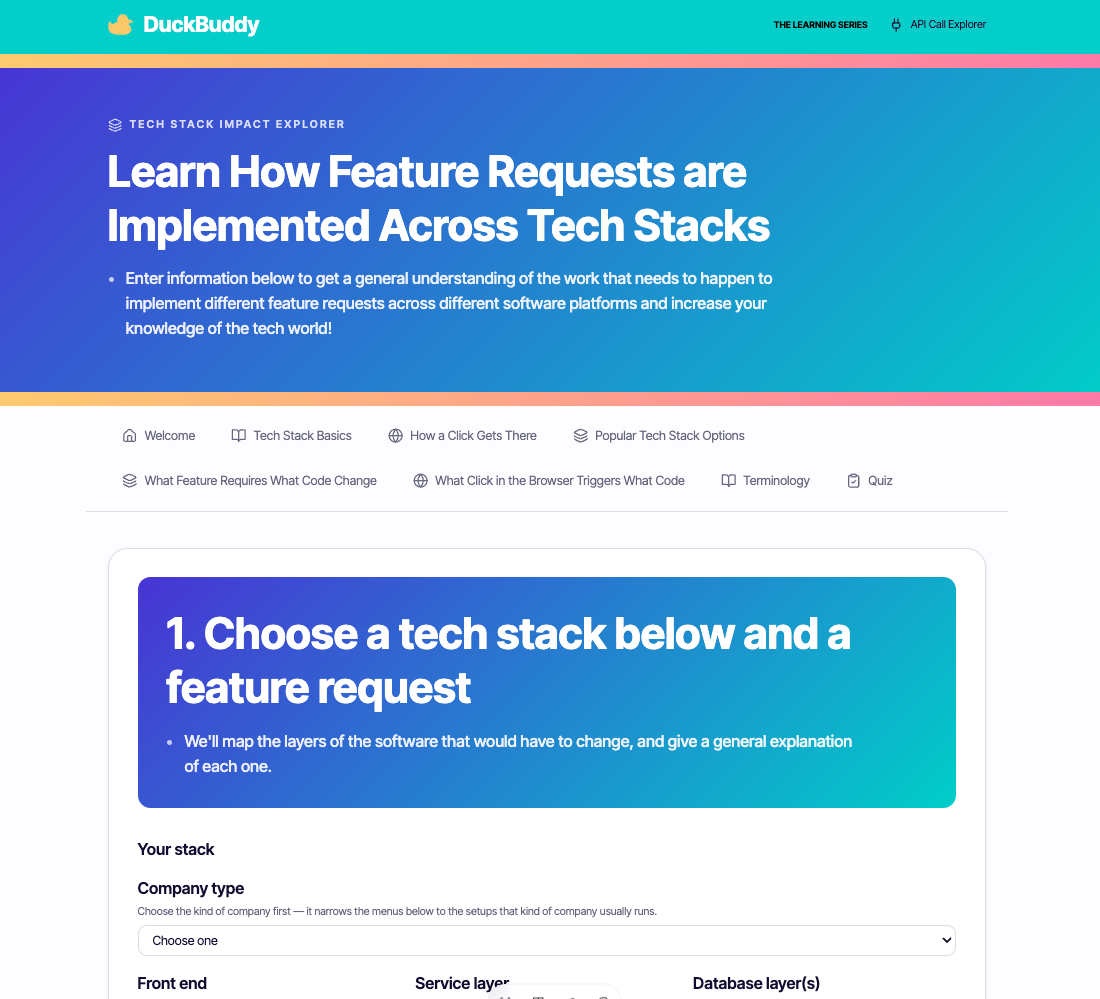
I used Lovable — an AI app builder where you describe an app in plain English and it builds a working web app, hosted and iterated in chat — to build a Tech Stack Explanation app.
Here's the prompt I used:
Prompt:
Build me a web app called "Tech Stack Explainer." It's a learning tool for non-developers. Here's what it needs to do:
Two inputs. First, a form where the user enters their tech stack — whatever they know of their company's stack. Include guided fields for the common layers: frontend (the UI), backend (the server and business logic), database, cloud storage, third-party integrations, and a free-text field for anything else they know. Not all fields are required — the user enters what they know.
Second input. A field where the user enters their feature request, in plain English. Something like "add a dashboard that shows all open support tickets by priority" or "let users upload profile photos."
The output. When the user submits, the app explains, layer by layer, which layers of the tech stack would need to be touched to build their request — and a basic, plain-English explanation of how each of those layers would need to change. Keep it high-level and readable. No jargon without a quick definition. If a layer probably wouldn't be touched, say so — and say why. This is about building understanding, not writing the actual code.
The note at the bottom. Every result page must end with a clear note: programming is just one part of the development process. All feature requests still have to go through an evaluation and prioritization period before any programming happens, and after the programming phase comes QA testing, a staging environment, and finally deployment. Building the code is one phase of a longer pipeline — the app should make that visible so users understand why "simple" requests take time.
Keep the design clean and simple. This is a learning tool, not a product.
What Lovable Did
Lovable built the working app in one pass: a guided form for the tech stack, the feature request field, and a results view that walks through each layer — frontend, backend, database, cloud storage, integrations — explaining in plain English whether that layer gets touched and what would change there. It even adds quick inline definitions for terms like "backend" and "staging" so a complete non-developer can follow along.
And it rendered the note at the bottom of every result exactly as intended: the full development pipeline — evaluation and prioritization before programming, then QA testing, staging, and deployment after — so nobody walks away thinking a feature is "just code."
Check our the Tech Stack Explainer tool that I built: Click here!
The Result
A learning tool that anyone can open, enter a stack and a request, and walk away with a genuine understanding of what their request would touch — and what happens to it after it's submitted. The kind of understanding that used to require years of proximity to a dev team.
And this is barely scratching what Lovable is for. It's a general-purpose builder for learning projects of every kind — websites, apps, interactive dashboards like this one. If you can describe the tool, you can have the tool.