From Garages to Glass Towers: How Tech Culture Ate Itself
Full article
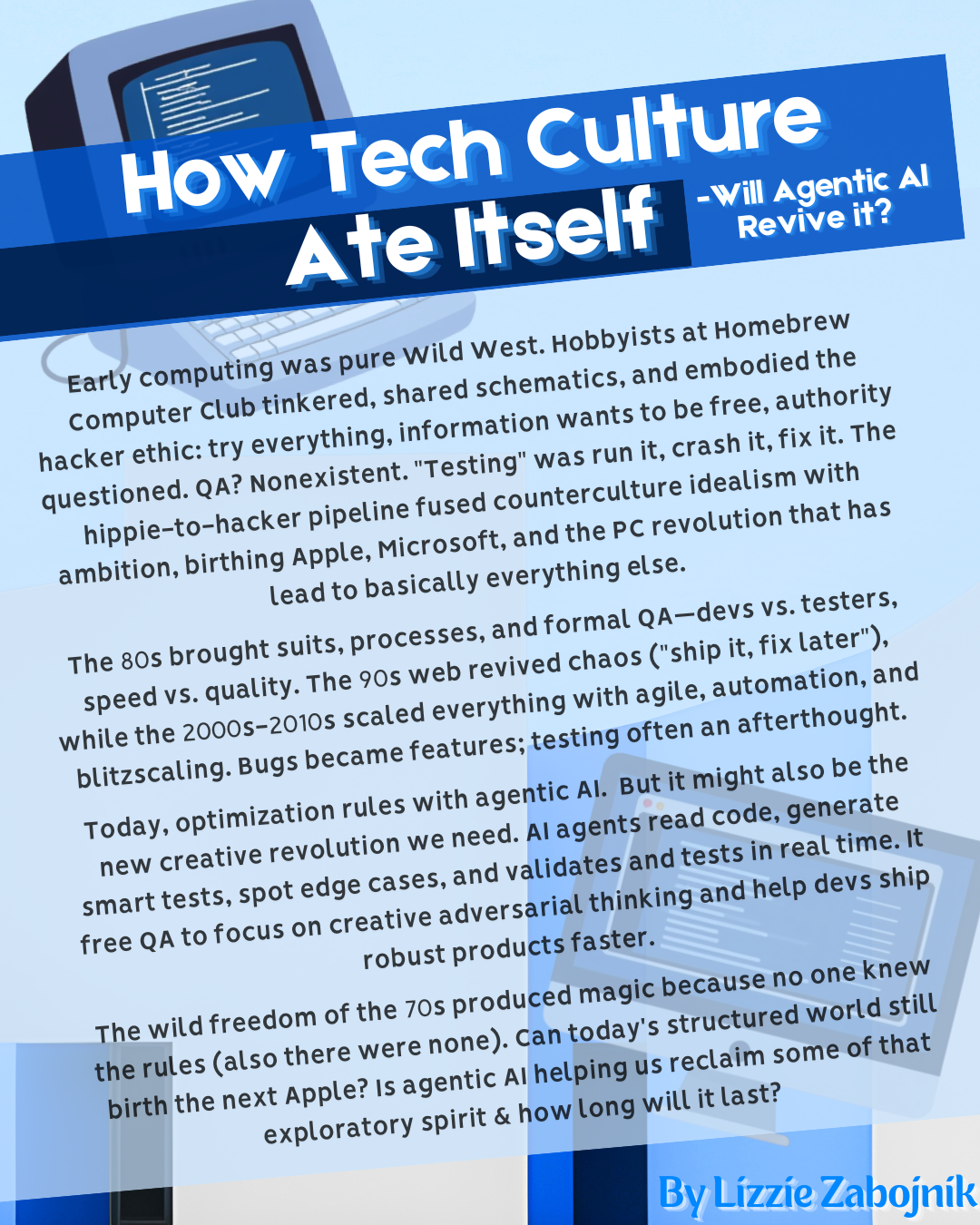
There's a particular kind of mythology that Silicon Valley loves to tell about itself. You know the one — two guys in a garage, soldering iron in hand, fueled by pizza and borderline reckless ambition, building something that changes the world. It's a good story. The thing is, it's mostly true. But what nobody tells you is how we got from that garage to the sanitized, perks-laden corporate campuses of today, and what we lost along the way.
And while we're at it — nobody talks about how we tested anything along the way, either. Because the story of quality assurance in tech is really the story of how a creative culture gradually convinced itself that breaking things was a personality trait instead of a problem to solve.
The Wild West: When Nobody Knew the Rules Yet
To understand where tech culture started, you have to understand that early computing wasn't an industry — it was an accident. The people who first fell in love with computers weren't entrepreneurs. They were tinkerers. Misfits. The kind of people who'd rather spend a Saturday inside a basement machine than outside doing literally anything else.
The 1960s and early 70s were the true wild west of computing. Computers were enormous, expensive, and locked behind institutional doors. If you wanted to play with one, you basically had to be at MIT, Stanford, or a defense contractor. Access was everything. And that scarcity bred a culture that was almost purely about curiosity. The early hackers at MIT's Tech Model Railroad Club didn't care about money. They cared about elegance. They cared about making a machine do something it wasn't supposed to do. The "hacker ethic," as it came to be called, was straightforward: information should be free, authority should be questioned, and code should be beautiful.
It was scrappy. It was unprofessional by design. Nobody had a business plan. Nobody had an MBA. The whole point was to explore.
And QA? QA didn't exist. "Testing" meant you ran your program and if it didn't crash, ship it. If it did crash, you fixed it and tried again. The idea of a dedicated person whose job was to find problems in someone else's code would have seemed almost offensive — if your code didn't work, that was your problem. The debugger was a print statement and a prayer. The only test suite was "does it do the thing I just built it to do?" In the wild west, you didn't test for bandits. You just rode through and hoped.
The Hobbyist Movement and the Homebrew Computer Club
Then something changed. In the mid-70s, semiconductor prices dropped enough that you could — if you were industrious, slightly unhinged, and willing to solder 47 connections yourself — build a computer in your kitchen. The Altair 8800 came out in 1975, and it was basically a box with blinking lights and switches. No keyboard. No screen. No practical use. And people went absolutely feral for it.
The Homebrew Computer Club in Menlo Park became ground zero. A bunch of engineers, hobbyists, and dreamers would meet and share schematics, debug each other's boards, and argue about what computing could become. It was communal, it was open, and it was radically anti-corporate. These were people who had watched IBM and DEC hoard computing behind paywalls and institutional gates, and they wanted to blow that up.
This is where the story gets interesting — and where the mythology starts to twist.
Testing at this point was still deeply personal and deeply manual. You built a board, you flipped the switches, you watched the lights. If bit 7 was wrong, you re-soldered. There was no automation because there was barely a machine to automate. But something important happened here: because the Homebrew culture was about sharing, bugs got found faster. More eyes on your schematic meant more chances someone spotted your mistake. It was informal, unstructured peer review — the first rough ancestor of what we'd now call community-driven testing. It wasn't QA as a discipline. It was QA as a vibe.
The Hippie-to-Hacker Pipeline
Here's the part that gets glossed over a lot: the early personal computing movement wasn't just a technical revolution. It was a cultural one, and it was deeply intertwined with the counterculture.
The 1960s had left a generation disillusioned with institutions — government, corporations, the military-industrial complex. The Vietnam War, Watergate, the bomb — trust in the establishment cratered. And when the counterculture movement didn't quite deliver the revolution it promised, a lot of those same people looked at technology and saw something different. Computers weren't just tools. They were a way to decentralize power. A mainframe was the Man. A personal computer on your desk was liberation.
Stewart Brand, the Whole Earth Catalog guy, literally said "information wants to be free" at the first Hackers Conference in 1984. The guy who helped define hippie counterculture was now standing in a room full of engineers saying that technology was the new frontier of freedom. This is the hippie-to-hacker pipeline, and it's the most important cultural merge in tech history.
You had people who grew up on communal living and anti-war protests now writing code and building hardware. They brought their values with them: share everything, question authority, build tools that empower individuals. But — and this is the crucial twist — they also brought their ambition.
Because here's the thing about counterculture capitalism: it lets you believe you're changing the world while you're also, you know, getting rich. And that tension — between idealism and profit — is the DNA of Silicon Valley. It's also, it turns out, the DNA of our complicated relationship with testing: we want to ship fast and we want things to not break, and those two desires have been mocking each other for fifty years.
Why the 70s Birthed Great Companies
So why did Apple, and Microsoft, and a dozen other legendary companies emerge from this specific moment?
It's simple: the culture of the 70s hobbyist scene combined radical creativity with a complete disregard for how things were "supposed" to be done. Nobody told Steve Wozniak that you needed a keyboard and a display to make a computer useful — he just built it that way because it was obviously better. Nobody told the Homebrew crowd that you shouldn't share your schematics — they just did it. There were no playbooks. No VC frameworks. No "how to scale your startup" podcasts. Just a bunch of people making it up as they went.
Apple is the perfect case study. Wozniak was a pure hacker — he just wanted to build cool stuff. Jobs was the counterculture capitalist — he'd been to India, experimented with a lot of things, he'd read the Whole Earth Catalog (a revolutionary 1960s counterculture magazine and product catalog which served as a pre-internet DIY guide that promoted self-sufficiency, ecology, holism, and alternative lifestyles) and he also understood that this stuff could be huge. Together, along with a third guy who never gets mentioned, they were the collision of hacker ethic and commercial ambition, and it worked precisely because neither of them knew the rules.
The companies that came out of this era were great because the people building them didn't know what was impossible. They were building in a vacuum. Nobody had written the business model for personal computing because there was no personal computing industry yet. Every assumption was up for grabs.
That creative freedom — that ruleless, messy, glorious freedom — is what made the 70s so productive. And yes, it also meant bugs. Lord, it meant bugs. The Apple I and Apple II had their share of hardware gremlins and software quirks. But in a world where you were inventing the category, "good enough" was genuinely good enough. The testing process was the user. The user was the test environment. And somehow, that worked — or at least, it worked well enough to build the future on top of.
The 80s: Suits Arrive
And then the adults showed up.
The 1980s were when tech went from a movement to a market. IBM entered the personal computer space in 1981, and suddenly there were standards. There were enterprise customers. There were marketing budgets and corporate hierarchies and people who said things like "market segmentation" without laughing.
The hacker ethic didn't die, but it got pushed underground. The IBM PC was open architecture, which was great, but the culture around it became... corporate. Microsoft's deal with IBM made Bill Gates the richest man in the world, and the story changed. You weren't a rebel anymore. You were an industry.
This was also when the first generation of tech workers started getting institutionalized. You went to work at a company. You had a cubicle. You had a manager. The scrappy, build-whatever-you-want energy of the 70s started getting channeled into product roadmaps and quarterly earnings.
But here's what also showed up in the 80s: the first real notion of software QA as a separate discipline. Because when IBM sells a PC to a Fortune 500 company, that company expects it to work. You can't just ship a bug and say "well, flip the switches again." The suits brought process, and process brought testing — real testing, with test plans and test cases and people whose entire job was to find problems before customers did. The role of "QA engineer" was born not out of hacker culture but out of corporate necessity. It was the right idea with the wrong cultural fit: developers, still high on the hacker ethic, often saw QA as bureaucracy. QA teams, meanwhile, were fighting for respect in a culture that prided itself on moving fast. This tension — devs vs. testers, speed vs. quality — became the defining conflict of software development for the next four decades.
The 80s also introduced the idea of software as intellectual property. Gates' famous "Open Letter to Hobbyists" in 1976 had already planted the flag — software isn't free, people should pay for it — and by the 80s, that view had won. Copying software went from being sharing to being piracy. The culture shifted from open and communal to closed and proprietary.
But — and this is important — the underground kept building. The BBS scene was thriving. Demo groups in Europe were pushing hardware beyond its limits just because they could. The hacker ethic didn't disappear. It just wasn't the mainstream anymore.
The 90s: The Internet Changes Everything (Again)
And then the internet happened, and for one brief, glorious moment, it felt like the 70s again.
The early web — roughly 1993 to 1999 — was the closest thing to the original hacker culture that had existed in decades. Nobody knew what the internet was for. There were no business models. Geocities pages were chaotic and ugly and deeply personal. Open source went from a Stallman crusade to a real movement with the rise of Linux. The culture was experimental, decentralized, and weird.
But the 90s also brought the dot-com boom, and with it, the most extreme version of counterculture capitalism yet. You had 23-year-olds raising millions of dollars for companies with no revenue because the internet was "different." The same idealistic energy that had driven the hobbyist movement was now being funneled into get-rich-quick schemes. The rhetoric was still about changing the world, but the reality was often about flipping IPOs.
Testing in the 90s was a strange split-screen. On one hand, the web ethos was "ship it, fix it later." The browser refresh was your deployment pipeline. If something broke, you pushed a new version and moved on. Iteration speed was everything. On the other hand, the enterprise side of the house was getting serious about QA. CMMI, ISO standards, formal test methodologies — the corporate testing world became more rigorous, more documented, more process-heavy. You had dev shops on one end pushing code live by the seat of their pants, and you had oracles and IBM consultants on the other end撰写 hundred-page test plans that nobody read. It was a mess, but it was a productive mess.
This was also when automated testing started to feel like a real thing. Tools like WinRunner and LoadRunner emerged to automate the mind-numbing repetition of clicking through the same UI flows over and over. Selenium, which would eventually become synonymous with browser testing, was born at the very end of this decade in 2004. The idea was simple: if humans have to do the same test fifty times, make the computer do it. It wasn't agentic. It wasn't smart. It was recording and playback, over and over. But it planted a seed.
When the bubble burst in 2000, it wiped out a lot of nonsense. But it also reinforced the idea that tech was fundamentally a business, not a movement. The naive idealism of the early web got replaced by something more pragmatic, more measured, and more corporate.
The Early 2000s: Post-Crash Pragmatism
After the crash, the culture shifted. The wild speculation died, and what replaced it was a more sober, builder-oriented mindset. This is the era of Web 2.0 — blogs, social media, user-generated content. The tools got simpler (Rails, AWS), the launches got faster, and the ethos was "build something useful, iterate quickly, figure out the business model later."
This was also when Google went from a search engine to a verb, and when the phrase "don't be evil" actually meant something. The culture had a rebellious streak again, but it was a polished rebellion. The casual outfits and open floor plans and free lunches were supposed to signal that you weren't IBM — but underneath, these companies were building the most sophisticated advertising and data extraction systems in human history.
The creative, rule-free spirit was still there, but it was more constrained. You could build whatever you wanted inside a startup, as long as you could explain how it would eventually make money. The garage was still the origin myth, but the reality was seed rounds and series A pitches and growth metrics.
Open source exploded during this period — Linux was everywhere, Apache was running most of the web — and that felt like the hacker ethic persisting. But even open source started getting absorbed into corporate structures. Red Hat wasn't a hobbyist project. It was a billion-dollar company.
This era also gave birth to the testing culture we'd recognize today. Kent Beck and the extreme programming movement popularized test-driven development — write your tests first, then write your code. It was almost subversive in its simplicity: force yourself to think about what could go wrong before you build the thing that will go wrong. JUnit landed in 2000 and turned unit testing from a nice idea into a standard practice, at least in theory. Continuous integration servers like CruiseControl and later Jenkins started running your tests automatically every time you committed code. The feedback loop tightened. You could find out your code was broken in minutes instead of weeks.
But here's the thing — and this is key — testing was still fundamentally separate from development. QA was a phase. A gate. A box to check. The devs wrote code, then threw it over the wall to QA, who ran the tests, found the bugs, and threw it back. It was better than nothing, but it still carried that original tension: speed vs. quality, builders vs. breakers, creators vs. critics. The tooling was modernizing, but the culture around it hadn't caught up.
The 2010s: The Platform Era and the Attention Economy
If the 2000s made tech polished, the 2010s made it omnipresent. Smartphones put a computer in every pocket. Social media went from "neat thing for sharing photos" to "primary engine of public discourse." The app economy made it possible for a two-person team to reach millions — but it also meant playing by Apple and Google's rules.
This is where the creative culture really started to calcify. The platform stores had review processes. The algorithms rewarded certain kinds of content. The funding environment rewarded certain kinds of startups. If your thing couldn't be explained in a YC interview, could it scale to a billion users, and would it eventually support a venture return, it wasn't getting built — at least not with institutional support.
The culture became about scale above all else. Move fast and break things. Growth hacking. Blitzscaling. The language of tech became indistinguishable from the language of finance. "Disruption" — originally an academic term about how small companies unseat incumbents — became a marketing buzzword. Every startup was "changing the world," which increasingly meant "trying to become a monopoly."
And "move fast and break things" — let's talk about that phrase. It was Facebook's motto, and it became the decade's defining philosophy. The implicit message: breaking things is the cost of innovation. QA was an afterthought, or worse, a revenue cost you could defer. The theory was that you could always fix it later, after you'd captured the market. And in a lot of cases, that's exactly what happened. Companies shipped buggy products, gained millions of users, and patched as they went. QA departments in big tech companies were gutted or outsourced. Testing became "quality engineering" or "developer productivity" or whatever title made it sound less like a cost center.
Meanwhile, the testing tools got dramatically better. Cypress replaced Selenium for a lot of front-end teams. Kubernetes and containerized infrastructure made test environments reproducible. The shift-left movement tried to push testing earlier in the pipeline — write tests alongside your code, run them in CI, catch bugs before they hit staging. And for the disciplined teams, it worked. But for every disciplined team, there were ten startups who considered testing a luxury they'd get to "after product-market fit." Which, spoiler, often meant never.
The hacker ethic didn't die. It just got professionalized. Hackathons became corporate recruiting events. "Maker culture" became a lifestyle brand sold at Target. The tools were more powerful than ever, but the creative, do-whatever-you-want energy was increasingly contained within frameworks — literal frameworks, like React and Flutter, and metaphorical frameworks, like startup methodology and venture expectations.
Now: Optimization Over Exploration — and the Agentic Turn
So where are we? Tech culture in the 2020s is... efficient. That's the nicest word for it.
The indie web and the creator economy have pockets of real creativity — people building weird, personal, interesting things. The AI explosion has created a genuine sense of possibility again, the first time in a while. There's open source energy around models and tools that feels a bit like the early internet.
But the dominant culture is optimization, not exploration. The major platforms are mature. The incentive structures are known. You build a SaaS. You find product-market fit. You scale. You exit. The pipeline is clear, and the pipeline is safe.
We went from a culture where nobody knew the rules to a culture where the rules are taught in accelerators. We went from "information wants to be free" to "your data is our product." We went from garages to campuses with nap pods and kombucha on tap, and somehow we call both of them innovation.
And testing? Testing is in the middle of its own revolution, and it's coming from the same place as everything else in 2020s tech: AI.
Here's the thing about QA that's always been true: nobody gets into software development because they love writing test cases. Testing is essential and everyone knows it, but it's also repetitive, tedious, and creatively unrewarding. For decades, we've tried to solve this with automation — record-and-playback scripts, unit test frameworks, CI pipelines. And all of that helped. But it didn't solve the fundamental problem: someone still has to write the tests, decide what to test, maintain the tests when the code changes, and interpret the results when tests fail. Testing has always been a labor bottleneck disguised as a technology problem.
Agentic AI is changing that. Not in the way that Selenium changed it — not by automating the clicks, but by understanding the context. Modern AI agents can read your codebase, understand what your application is supposed to do, and generate tests that actually cover the logic that matters, not just the happy path. They can look at a pull request and figure out which edge cases the developer probably didn't think about. They can prioritize which tests to run based on what changed. They can even explain why a test failed, in plain language, instead of just dumping a stack trace that sends you on a two-hour debugging scavenger hunt.
This isn't replacing QA testers — it's giving them superpowers. The best QA engineers have always been the ones who think adversarially, who ask "what happens if the user does something stupid?" and "what happens if the network drops mid-request?" Those are creative questions. The tedious part was turning those questions into reproducible test cases, running them across environments, and maintaining them as the code evolved. Agentic AI takes the mechanical parts off the table and lets QA focus on what it was always supposed to be: a creative, adversarial discipline that thinks about failure in ways developers don't.
For developers, it means testing stops being the thing you do after the real work is done. AI agents can generate tests as you write code, flag risks in real time, and catch regressions before they metastasize. The old adversarial dynamic between dev and QA — the wall, the throw-over, the bug ping-pong — starts to dissolve when an AI agent is sitting in the middle, translating between the builder's intent and the breaker's perspective.
And there's something beautifully circular about this. The 70s hacker culture had no formal QA, just people sharing code and catching each other's bugs in an informal, communal way. The 80s and 90s built walls between developers and testers to try to cut down on the chaos and standardize things as growth started to explode (not always bad but..). The 2000s and 2010s tried to tear those walls down with better tooling but mostly just made the conveyor belt faster. As technology keeps exploding the pressure to do more now gets greater and greater. These days, agentic AI is creating a kind of always-on peer review, which helps with the speed and efficiency that companies are racing at in order to stay relevant in the fast changing market. This is not a bureaucratic gate, not a phase in a pipeline, but a continuous collaborator that understands your code in real time (for those that use it), questions your assumptions, and helps you build something that actually works. The better that it works in the development phase, the better it will work in the QA testing phase, of course QA testers are also using agents to speed up and do more tests in less time as well. Together all of this produces a better working product for the end customer.
The thing about the wild west era of tech isn't that it was necessarily better. A lot of it was chaotic, exclusionary (the hobbyist scene was overwhelmingly white and male, which is a whole other essay), and impractical long term on a wide market scale. But it was free in a way that matters. When you don't know what's possible, you try everything and thinking outside the box is normal because there is no box. When the rules are clear and set, you tend to optimize within them. And optimization, for all its power, rarely produces the kind of thing that makes you stop and say "whoa."
Apple happened because two guys in a garage didn't know what was impossible. They were doing what they love, being who they were, and just putting in effort to make something. The next Apple — will happen the same way. The question is whether today's culture still has room for that or if rules, procedures, and management hierarchies have almost squashed the chance for that.